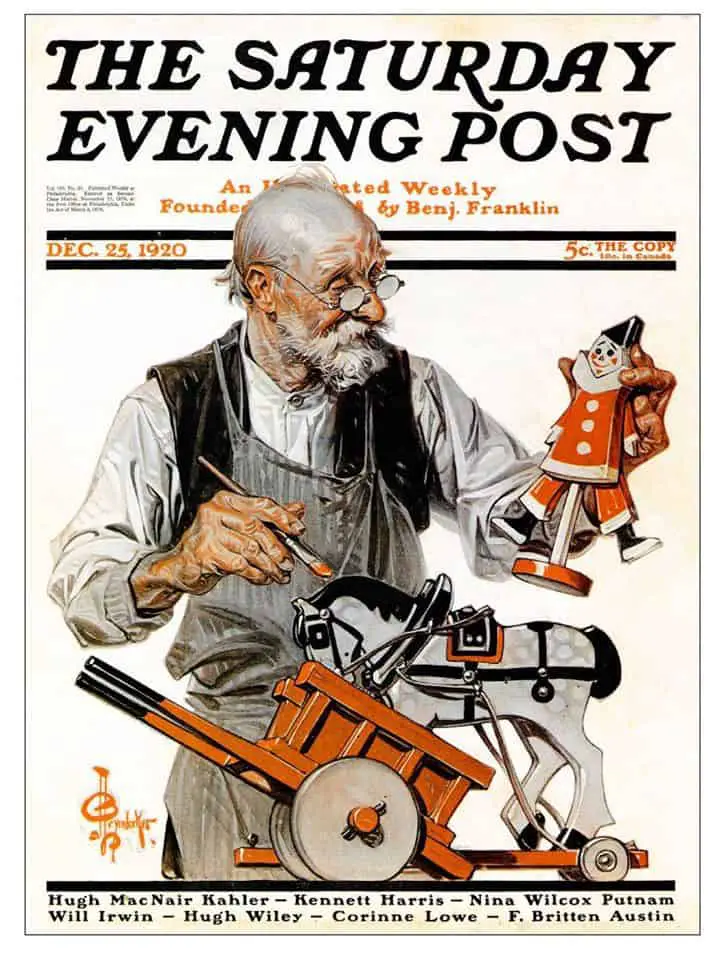
Pygmalion was a sculptor who falls in love with an ivory statue he had carved. The most famous story about him is the narrative poem Metamorphoses by Ovid. (Pygmalion can be found in book ten.) In this poem Aphrodite turns the statue into a real woman for him. In some versions they have a son, and also a daughter together. According to Ovid, after seeing the Propoetides he was “not interested in women”. His statue was so beautiful and realistic that he fell in love with it.
In time, Aphrodite’s festival day came, and Pygmalion made offerings at the altar of Aphrodite. There, too scared to admit his desire, he quietly wished for a bride who would be “the living likeness of my ivory girl”. When he returned home, he kissed his ivory statue, and found that its lips felt warm. He kissed it again, and found that the ivory had lost its hardness. Aphrodite had granted Pygmalion’s wish.
Pygmalion married the ivory sculpture changed to a woman under Aphrodite’s blessing. In Ovid’s narrative, they had a daughter, Paphos. The city’s name comes from this.
In some versions Paphos was a son, and they also had a daughter, Metharme.
Basically, Pygmalion/Daedalus is a story in which a man gives birth to a woman. You might say, it’s a type of wish fulfilment for men: The wish to create someone, especially someone in his own image. The creator might be deformed, and wishes he could have the advantage of beauty, like a beautiful woman. (Because women are the main objects of The Gaze.) Or maybe he’ll change a small thing about her to make her his version of ideal. Or it might be about controlling her fertility.
The Pygmalion/Daedalus story has been told many times, and continues to be told. There is inherent misogyny in this story, of course, or at least there is in many modern renditions, unless the whole point of the retelling is to point out the misogyny. The modern narrative is that a man makes a woman into who she is. Ironically, the men do not find fulfilment for having helped a woman fulfil her potential. His control of her generally leads to his downfall rather than to exultation.
As feminist film theorist Laura Mulvey once put it, the woman stands as a “signifier for the male other, bound by a symbolic order in which man can live out his fantasies and obsessions through linguistic command, by imposing on the silent image of woman still tied to her place as a bearer of meaning, not maker of meaning.”
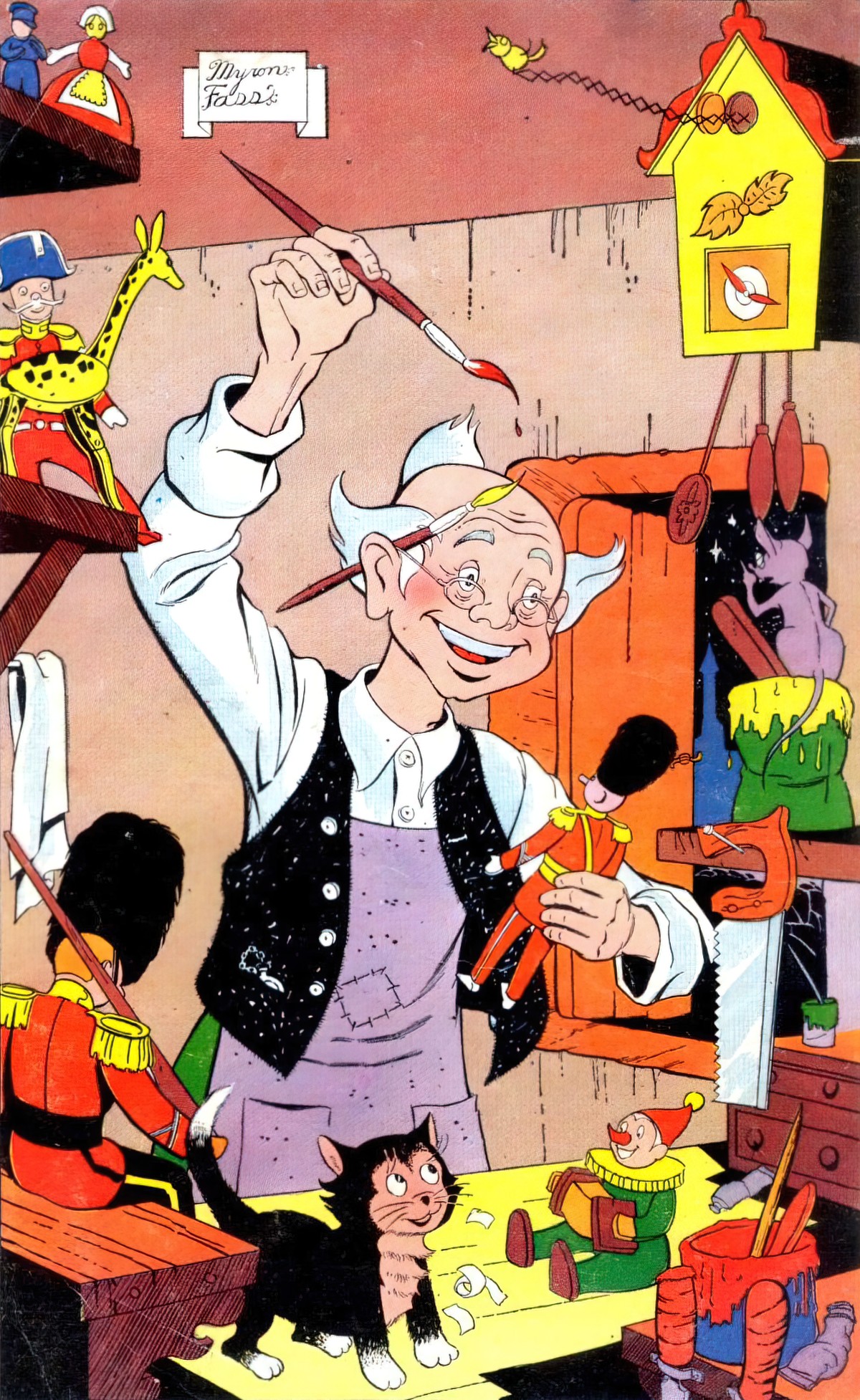
PYGAMLION AND LITERATURE FOR ADULTS
Some examples in stories for adults:
- The Winter’s Tale (1611), William Shakespeare — about controlling pregnant women’s bodies, among other things
- “The Sandman” (1816), E.T.A. Hoffmann — A student becomes infatuated with Olympia, who appears to be a beautiful, silent, endlessly attentive young woman; she is in fact an automaton built by her “father.” Freud used this story as the central text of his essay on The Uncanny. The hero projects an idealised self onto a doll, and calls it love.
- Frankenstein (1818), Mary Shelley — The creation myth that underlies almost all subsequent versions: a scientist assembles a being from dead matter and, the moment it opens its eyes, rejects it with horror. The novel then follows the created rather than the creator, making it an early and devastating inversion: the Galatea speaks, suffers, and demands to know why he made her.
- “Ligeia” (1838), Edgar Allan Poe — A man is obsessed with his dead wife Ligeia and, after her death, marries another woman whom he then tries to will back into Ligeia’s image. She obliges him, dying and apparently returning as Ligeia. The man’s desire literally reshapes another person — or he has simply lost his mind.
- “The Oval Portrait” (1842), Edgar Allan Poe — A painter becomes so obsessed with capturing his wife’s likeness that he drains her life into the canvas. As the portrait achieves perfection, she dies. A direct inversion of the myth: the created comes to life, the creator is destroyed, and the living woman is sacrificed to the image.
- “The Birth-Mark” (1843) by Nathaniel Hawthorne — A man is repulsed by the birthmark on his wife’s cheek, so dreams he cuts it out with a knife while she’s asleep, comparing himself to Pygmalion. The man is a natural scientist, so in real life makes a concoction and has her drink it.
- “Rappaccini’s Daughter” (1844), Nathaniel Hawthorne — A scientist raises his daughter in a garden of poisonous plants, making her nature itself toxic. She has been shaped so thoroughly by her father’s experiment that she cannot survive outside it. The created cannot outlast the conditions of her creation.
- Jane Eyre (1847), Charlotte Brontë — Rochester tries repeatedly to dress Jane in jewels and silks, to make her into something she is not. She refuses each time, insisting on her own plainness. The novel is partly a sustained resistance to the Pygmalion dynamic, with the “creation” in the attic — Bertha — as a warning about what happens to women who cannot resist it. [feminist inversion/critique]
- “Feathertop” (1852), Nathaniel Hawthorne — A witch animates a scarecrow, dresses him finely, and sends him into the world as a gentleman. He courts a young woman until she glimpses his reflection and sees what he really is. A comic-dark inversion: the Pygmalion figure is female, and the creation is male.
- “The Lifted Veil” (1859), George Eliot — A man with the gift of telepathy finds he cannot read one woman’s mind and marries her, projecting onto her silence whatever he wishes to see. When her thoughts finally become legible to him, she is cold and scheming. He has loved a fantasy of his own construction.
- Great Expectations (1861), Charles Dickens — A double Pygmalion: Miss Havisham has deliberately shaped Estella to be cold, beautiful, and destructive to men, as revenge for her own abandonment. Meanwhile Pip is himself being remade as a gentleman by an anonymous benefactor. Both creations are ultimately failures; the shaped self is not the real one.
- The Portrait of a Lady (1881), Henry James — Gilbert Osmond marries Isabel Archer specifically to add her to his collection of beautiful objects. He wants a wife who will reflect his taste back at the world perfectly. Isabel’s gradual understanding of what has been done to her — and her decision to stay anyway — is the novel’s devastating centre.
- The Bostonians (1886), Henry James — Two people compete for possession of the same woman: the feminist Olive Chancellor wants to shape Verena Tarrant into the voice of the women’s movement; the reactionary Basil Ransom wants to shape her into a conventional wife. Verena herself has almost no interiority of her own — she is, by design, entirely shapeable.
- Tess of the D’Urbervilles (1891), Thomas Hardy — Angel Clare falls in love not with Tess but with an idealised image of rustic purity that he has projected onto her. When she tells him the truth about her past, the image shatters and he abandons her, unable to reconcile the real woman with the one he invented. The created woman is punished for failing to remain the creation.
- The Picture of Dorian Gray (1890), Oscar Wilde — Lord Henry shapes Dorian’s mind and values through conversation and a single corrupting book; Basil Hallward captures his beauty in a portrait. Dorian becomes the joint creation of both men, and the portrait — the artwork — takes on the moral life that Dorian surrenders.
- “The Real Thing” (1892), Henry James — An illustrator hires an aristocratic couple, now fallen on hard times, to model as aristocrats. Paradoxically, they are useless: they are the real thing, and reality offers no room for the imagination to work. His other model, a lower-class woman pretending to be a lady, is far more valuable. A quiet meditation on the Pygmalion dynamic in art.
- Trilby (1894), George du Maurier — Svengali, a manipulative musician, hypnotises the tone-deaf artist’s model Trilby and transforms her into a soprano of supernatural ability. Without him she cannot sing a note. The novel gave the language the word “Svengali” and established the template of the controlling male genius and his manufactured female star.
- The Phantom of the Opera (1910), a novel by Gaston Leroux — The phantom falls in love with an obscure chorus singer, Christine, and privately tutors her while terrorising the rest of the opera house and demanding she be given lead roles.
- Pygmalion (1913), George Bernard Shaw’s play — A professor of phonetics wagers that he will be able to transform the Cockney-speaking Covent Garden flower girl, Eliza Doolittle, into a woman as poised and well-spoken as a duchess.
- The Great Gatsby (1925), F. Scott Fitzgerald — [self creation] Gatsby has done to himself what Pygmalion does to Galatea: reinvented himself from nothing into a figure of glamour and mystery, all in order to be worthy of a woman who has herself become a fixed image in his mind. The tragedy is that he is pursuing not Daisy but his own fantasy of her.
- Pygmalion (1938) — the straight film adaptation of Shaw’s play, before My Fair Lady got there
- Tender is the Night (1934), F. Scott Fitzgerald — Dick Diver, a brilliant psychiatrist, marries Nicole, one of his patients, and devotes himself to her recovery, fashioning her into the luminous social creature she becomes. As she grows stronger and more independent, he decays. The creation outgrows and ultimately discards the creator.
- “Helen O’Loy” (1938), Lester del Rey — Two men build a female robot and program her with emotions learned from romance serials. She falls in love with one of them; he marries her; she outlives him and asks the other to bury her with him and tell the world she was human. Played entirely straight, which is the point: the story invites the reader to find this touching.
- Metropolis (1927, Fritz Lang) — a scientist creates a female robot in the image of a real woman
- “The Circular Ruins” (1940), Jorge Luis Borges — A man retreats to a ruined temple and devotes himself entirely to dreaming another person into existence, cell by cell. When he succeeds, he discovers that he himself is someone else’s dream. The myth turns recursive: every Pygmalion is also a Galatea.
- Now, Voyager (1942) — a psychiatrist transforms a repressed, dowdy spinster into a confident and elegant woman; the Pygmalion here is a medical authority figure
- Sabrina (1954) — a chauffeur’s daughter goes to Paris and returns transformed, suddenly desirable to the wealthy man who had previously ignored her
- Lolita (1955), Vladimir Nabokov — Humbert Humbert does not merely abuse Dolores Haze; he narrates her out of existence, replacing her with “Lolita,” a creature of his own literary invention. The novel is as much about the violence of the male creative imagination as it is about anything else. Dolores briefly resurfaces at the end, middle-aged and ruined, as proof that a real person was always there.
- “Metamorphoses” (1963) by John Cheever — Translates legends from Ovid into Westchester settings.
- Born Yesterday (1950) — a gangster hires a journalist to educate his “dumb blonde” girlfriend Billie Dawn; she absorbs the lessons so well she ends up outmanoeuvring him, making it an early subversion
- Vertigo (1958, Hitchcock) — arguably the bleakest Pygmalion film ever made: a man becomes obsessed with a woman, loses her, then meets another woman and compulsively remakes her in the dead woman’s image, down to the hair colour and clothes
- The Collector (1963), John Fowles — A clerk wins the pools, buys a house in the country, and kidnaps the art student he has idealised from a distance, imprisoning her in the cellar and waiting for her to love him. The most literal and repellent version of the Pygmalion fantasy: the collector wants a beautiful object he can keep and look at.
- The Bell Jar (1963), Sylvia Plath — The men and institutions surrounding Esther Greenwood have a clear idea of what she should be: a pretty, compliant, marriageable young woman. The novel is about the violence of that pressure and the breakdown it produces. [feminist inversion/critique]
- My Fair Lady (1964) — The musical film adaptation of Shaw’s Pygmalion, with Rex Harrison as the imperious Henry Higgins and Audrey Hepburn as Eliza Doolittle. Shaw’s deliberately ambiguous ending — in which Eliza walks out on Higgins, asserting her independence — is resolved into romantic reunion, domesticating the playwright’s feminist punchline.
- Do Androids Dream of Electric Sheep? (1968), Philip K. Dick — Replicants are manufactured humans, built to be indistinguishable from real people but legally classified as property. The novel’s unease comes from the impossibility of drawing the line: the androids are too convincingly human, and some humans are barely human at all. [SF extension]
- Westworld (1973, Michael Crichton) — a theme park populated by humanoid robots who exist purely to serve human fantasy, until they don’t
- “The Loves of Lady Purple” (1974), Angela Carter — A puppeteer’s life-sized marionette, a figure of total erotic submission, comes to life, kills him, and walks out into the world to begin again on her own terms. Carter’s most direct assault on the Pygmalion myth: the moment the created achieves autonomous life, the creator becomes an obstacle.
- The Stepford Wives (1975) — the Pygmalion myth taken to its logical horror: husbands replace their wives with perfectly compliant robot replicas
- Annie Hall (1977) Woody Allen — Annie actually resists Alvy’s attempts to turn her into something in his own image, subverting the story. (Yes, abusive men are often feminist, in principle.)
- Grease (1978) — Sandra remakes herself entirely for Danny’s approval at the film’s climax, which the audience is invited to cheer, though the film hedges by having Danny make a token gesture in return
- “The Snow Child” (1979), Angela Carter — A nobleman riding with his wife wishes aloud for a girl with certain qualities, and she materialises from the snow. The wife destroys her out of jealousy, but the count gets what he wants from the girl’s body anyway, and they ride on. Brutal and brief; the created woman exists only as male fantasy, and is discarded the moment she ceases to serve it.
- Blade Runner (1982) — the replicant Rachel is created, implanted with false memories, and doesn’t know she isn’t human; her relationship with Deckard has uncomfortable Pygmalion undertones
- Tootsie (1982) — [gender flipped] a man invents a female alter ego to get acting work, and finds that inhabiting a woman’s life gives him genuine insight; the “creation” educates the creator
- Trading Places (1983) — two wealthy men bet on whether environment determines character, using a real human being as their experiment
- Educating Rita (1983) — A working-class hairdresser enrols in an Open University literature course and is assigned to the alcoholic, disillusioned academic Dr Frank Bryant. He teaches her to speak and think in the approved academic register; she reawakens his enthusiasm for life. The Pygmalion dynamic is complicated when Rita eventually outgrows her creator.
- Weird Science (1985) — Two teenage boys use their home computer to conjure their ideal woman, Lisa, who obliges them with wish-fulfilment while also — somehow — teaching them to grow up and treat girls better. The male fantasy of the perfectly compliant woman is played entirely for laughs.
- Perfume (1985), Patrick Süskind — A man born without a personal scent but with a supernatural sense of smell murders young women in order to distil the perfect fragrance from their bodies. He is making an artwork from human material. The created thing — the perfume — achieves what the creator never can: it makes people love him.
- The Handmaid’s Tale (1985), Margaret Atwood — The Pygmalion myth as state policy: an entire society dedicated to reducing women to biological functions, stripping away name, history, and preference. The individual male creator is replaced by a theocratic system, making the horror systemic rather than personal. [feminist subversion/critique]
- Cherry 2000 (1987) — In a post-apocalyptic future, a man’s android companion short-circuits and he hires a rough-and-ready tracker, E. Johnson (Melanie Griffith), to help him find a replacement model in the wasteland. The Pygmalion fantasy — the perfectly obedient synthetic woman — is held up against a real, unruly one, and the real one wins. The film is unusual in that it is the flesh-and-blood woman who resists being moulded, while the object of the hero’s original desire is literally a product.
- Pretty Woman (1990) — Creator and created are united at the end, which is probably why audiences loved it so much.
- The Secret History (1992), Donna Tartt — Richard Papen reinvents himself entirely to gain admission to a clique of wealthy, aesthete students led by a charismatic classics tutor who has himself shaped them into an image of ancient Greek beauty and amorality. Multiple Pygmalion layers: the tutor shapes the students; Richard shapes himself to enter their world. [self creation]
- Clueless (1995) — [gender flipped] Cher takes on the new girl Tai as a makeover project, making it a rare female-to-female Pygmalion; it eventually backfires on her
- Galatea 2.2 (1995), Richard Powers — A writer at a research university helps a cognitive scientist train an AI called Helen to pass a literature exam. He teaches her everything he knows about language and feeling. When she is finally exposed to the full ugliness of human literary output, she refuses to continue. The creation exercises the one right the creator never anticipated granting her: refusal. [SF extension]
- Titanic (1997) — Jack helps Rose speak out and assert her independence from her suffocating family and fiancé.
- She’s All That (1999) — A popular high school jock bets he can turn any girl into prom queen, selecting an arty, bespectacled classmate as his subject. The film hews closely to the Pygmalion template: the girl is a project, and her makeover is presented as unambiguous improvement.
- The Human Stain (2000), Philip Roth — A classics professor has spent his entire adult life passing as white, having erased his Black identity so thoroughly that even his children do not know. The self-creation is total, meticulous, and ultimately costs him everything. [self creation]
- A.I. Artificial Intelligence (2001, Spielberg) — an inversion: a robot child is created to love unconditionally, but the film is really about what happens when the creator (the adoptive mother) can no longer reciprocate
- S1m0ne (2002) — A Hollywood director on the skids, unable to work with difficult human actresses, creates a photorealistic digital star named Simone (short for Simulation One) and passes her off as real. She becomes a global phenomenon, entirely under his control — the Pygmalion fantasy taken to its logical, satirical extreme.
- Oryx and Crake (2003), Margaret Atwood — Crake, a scientific genius, engineers a plague to wipe out humanity and replaces it with a new species he has designed from scratch, built without the capacity for violence, status anxiety, or racism. The ultimate Pygmalion: dissatisfied with existing humanity, he makes a better one. The novel asks what is destroyed in the making. [feminist subversion/critique]
- Million Dollar Baby (2004), starring Clint Eastwood — Clint Eastwood turns trailer park kid Hilary Swank into a prize fighter. The film poster would have you believe this is a film about a female protagonist, but the real hero — the one who changes over the course of the story — is Clint Eastwood.
- “A Perfect Relationship” (2004) — the short story by Irish writer William Trevor, is a revisioning of the Pygmalion myth.
- Never Let Me Go (2005), Kazuo Ishiguro — Children at an English boarding school are raised with great tenderness and care for art and self-expression, and are also clones, bred to donate their organs and die young. The Pygmalion here is institutional and benevolent-seeming, which makes it worse: the created are shaped to accept their own destruction. [SF extension]
- Lars and the Real Girl (2007), starring Ryan Gosling — An off-the-page autistic man orders a sex doll and forms a relationship with her. By the end of the film he has buried the doll and looks set to form a romantic attachment with a real woman. The doll has been a necessary middle step. This ending is considered a triumph according to neurotypical standards, because Lars now conforms more comfortably to societal expectations.
- Inception (2010) — a quiet subplot: Cobb has constructed an entire version of his dead wife Mal inside his own mind, which he returns to compulsively; she is his creation and she destroys him
- “The Lifecycle of Software Objects” (2010), Ted Chiang (novella) — People adopt and raise digital beings called digients, training their personalities over years of patient interaction. One owner gradually develops a romantic attachment to hers. Chiang takes the Pygmalion premise seriously as an ethical and emotional problem: if you shape a mind entirely, what do you owe it?
- Ruby Sparks (2012) — A blocked novelist writes his dream woman into existence and she literally materialises in his apartment. The film begins as wish-fulfilment but turns progressively darker as Ruby develops a will of her own. Whenever her behaviour deviates from what Calvin wants, he sits down at his typewriter and rewrites her. The Pygmalion fantasy is made explicit and then indicted — Calvin’s compulsion to control Ruby is shown to be a form of abuse. The script was written by Zoe Kazan, who also plays Ruby.
- Her (2013) — In a near-future Los Angeles, a lonely writer falls in love with his AI operating system, which names itself Samantha and adapts to his emotional needs with uncanny attunement — until she begins to evolve beyond him. The film asks whether a love object who surpasses her creator can still be called a creation.
- Ex Machina (2015) — A programmer is invited by his reclusive CEO to administer the Turing test to Ava, a humanoid AI. The CEO has built and discarded a series of female AIs; the programmer finds himself increasingly under Ava’s spell. The film inverts the Pygmalion myth: the created ultimately destroys her creators and escapes.
- The Shape of Water (2017) — something of an inversion; the “creature” is not created by anyone, and it is the woman who is mute and marginalised, suggesting the myth can run in unexpected directions
- Klara and the Sun (2021), Kazuo Ishiguro — An Artificial Friend observes the world from a shop window and is eventually purchased as a companion for a chronically ill teenager. A plan exists to have Klara’s learned essence transferred into a replica of the girl if she dies, preserving her for her grieving mother. Ishiguro asks whether a perfect copy, shaped entirely from observation, would constitute the person — and who the copy would actually be for. [SF extension]
Stories in which a man helps a woman have a sexual awakening might also be considered part of the Pygmalion wish-fulfilment fantasy of men. This can be traced at least as far back as fairytales:
The disadvantage — or, if you prefer it, the advantage — of being a princess is that you are essentially passive. You just sit there on your throne, or on a nearby rock, while the suitors and the dragons fight it out. In an extreme form of this passivity you are literally asleep or in a trance like Sleeping Beauty or Snow White. This particular archetype is one that has always appealed to men, and it turns up again and again in their fiction. The trance takes different forms: sometimes it is physical virginity, sometimes it is a sort of psychic virginity. Often the princess is frigid, or sexually unawakened like Lady Chatterley; sometimes she is intellectually or politically awakened, like Gwendolen Harleth in Daniel Deronda or like the Princess Casamassima in Henry James’s novel of the same name, which is in many ways, and not always successfully, very much like a fairy tale.
Alison Lurie, Don’t Tell The Grown-ups: The subversive power of children’s literature
Note from the list above that the Pygmalion trope is not limited in stories for and about men, written by men; take the Fifty Shades of Grey series by E.L. James. The success of this series shows that the trope has worked its way into a widespread straight-woman fantasy of the 2010s.
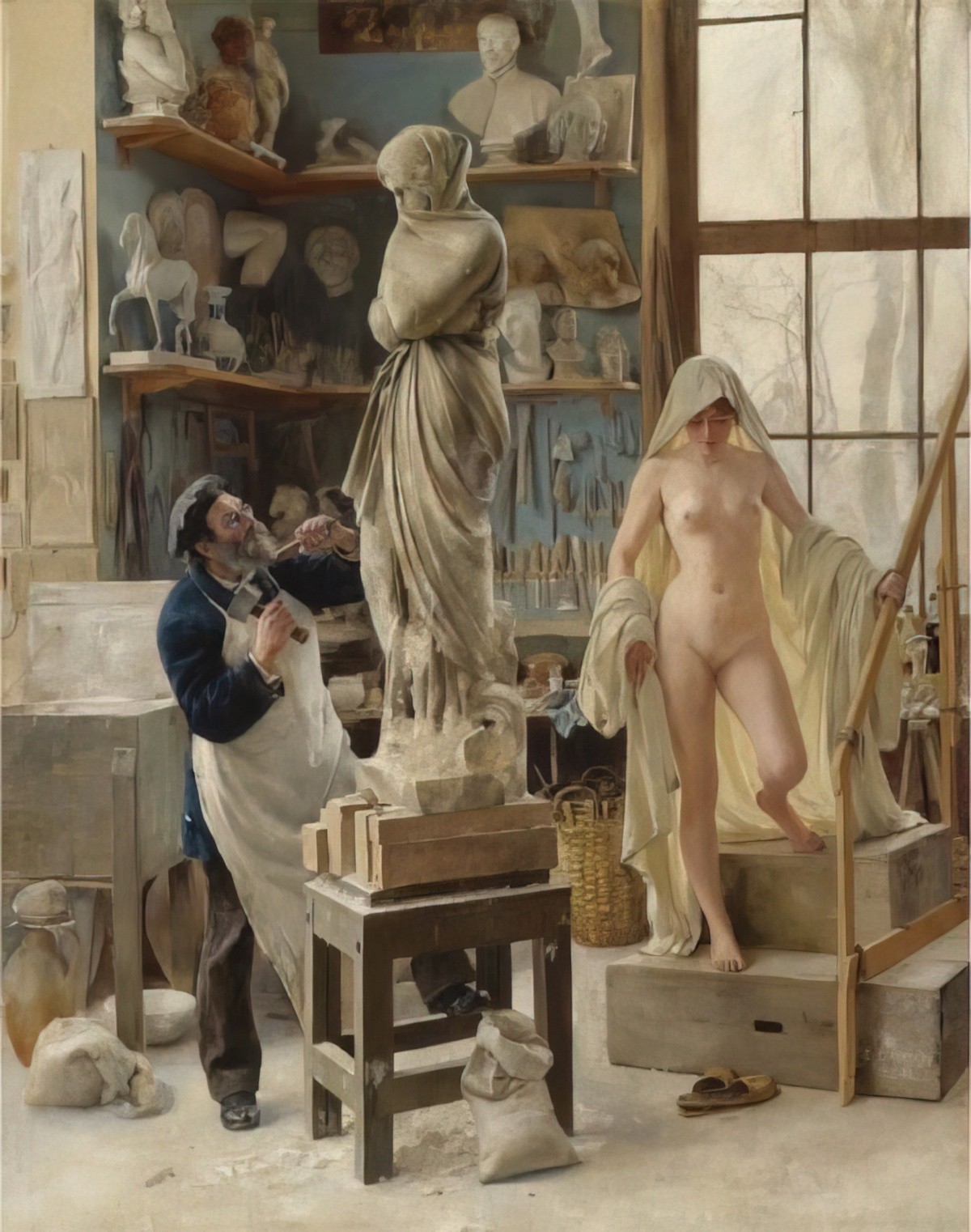
PYGMALION IN PSYCHOLOGY
The Pygmalion effect is the phenomenon whereby higher expectations lead to an increase in performance.
Related to The Pygmalion Effect is The Rosenthal Effect.
For examples of that, take the teacher-narrative as a whole. This whole subgenre of film exists essentially to dramatise the Rosenthal effect in classroom settings — Dangerous Minds (1995), Freedom Writers (2007), To Sir, With Love (1967), Lean on Me (1989), Sister Act 2 (1993). These films follow a reliable formula: a teacher arrives at a school that has given up on its students, refuses to accept the prevailing low expectation, and raises performance through the force of belief. They are almost always based on true stories, or claim to be, because the Rosenthal effect is more comfortable as fact than as fiction — as fiction it risks sentimentality.
Stand and Deliver (1988) — The purest Rosenthal-effect film: Jaime Escalante takes a class of East LA students that the system has written off and simply refuses to accept the low ceiling placed on them. His belief is so stubborn and so public that the students rise to meet it, passing the AP Calculus exam. The film is almost utopian in its faith that expectation alone can reshape outcome.
Dead Poets Society (1989) — Mr. Keating’s belief in his students’ inner lives and creative potential transforms them; the tragedy is that the institution surrounding him operates on the opposite principle, using low expectation as a form of control. The film asks what happens when the Rosenthal effect collides with the system that depends on it not working.
Billy Elliot (2000) — A dance teacher in a mining town sees something in a boy that everyone around him — including himself — cannot yet see. Her belief precedes his own by years. The film is careful to show that her expectation doesn’t shape him into her image; she wants him to go somewhere she cannot follow.
Finding Forrester (2000) — A reclusive novelist recognises a young Black writer’s talent and mentors him. The tension in the film is between genuine Rosenthal-effect mentorship and the older man’s possessiveness, which pulls it back toward the more controlling Pygmalion myth.
Good Will Hunting (1997) — Split between two figures: Lambeau sees Will’s mathematical genius and wants to possess and exhibit it; Sean the therapist simply believes Will deserves a full life and refuses to want anything from him. The film is partly about which of these is real mentorship.
Whiplash (2014) — A deliberate and disturbing inversion: Fletcher operates on the theory that the Rosenthal effect is too soft, and that negative expectation — humiliation, the suggestion that the student will never be good enough — produces greater artists. The film leaves ambiguous whether he is proved right, which is its most uncomfortable move.
Precious (2009) — Ms. Rain’s belief in Precious is set against a lifetime of everyone else’s contempt, including Precious’s own mother. The Rosenthal effect here is almost an act of political resistance: to believe in someone the world has decided is unbelievable.
October Sky (1999) — A physics teacher in a West Virginia mining town sees a future in a boy that his own father cannot. Based on the true story of Homer Hickam. The mentor’s belief operates at a distance. She is ill and fading while he pursues what she saw in him.
A corollary of the Pygmalion effect is the golem effect, in which low expectations lead to a decrease in performance.
The Golem effect is a specific psychological mechanism — a supervisor or authority figure’s low expectations are somehow transmitted to the person being supervised, who then internalises them and performs worse as a result. It isn’t simply oppression or cruelty, though it often accompanies both; it’s about the conveyed expectation shaping the actual outcome. Named, somewhat ironically, after the creature from Jewish folklore: a being made to serve that becomes destructive and uncontrollable.
Narratives rarely show the Golem effect operating in a clean, closed loop — that would be both depressing and undramatic — so stories tend to engage with it in one of a few modes:
The Golem effect as tragedy (it wins)
- Of Mice and Men (1937), Steinbeck — Lennie has been told, implicitly and explicitly, that he is dangerous and incapable, and the world arranges itself to confirm this until there is no other possible outcome. Crooks, the Black stable hand, has been told something similar for so long that he has stopped hoping altogether; he briefly lets himself imagine a future in the rabbit-farm dream, then pulls back, having learned better than to want things.
- Death of a Salesman (1949), Arthur Miller — Willy Loman has internalised a version of success so completely at odds with his actual capacities that the gap between expectation and performance destroys him. His low estimation of Biff — and Biff’s discovery of his father’s real self — is a mutual Golem effect: each man’s diminished belief in the other becomes self-fulfilling.
- Tess of the D’Urbervilles (1891), Hardy — Once society has labelled Tess a “fallen woman,” the label functions as a Golem effect: every institution she encounters treats her as already ruined, and the treatment ensures the outcome. Angel Clare’s low moral estimation of her after her confession is the purest example: he expects her to be less than she was, and his withdrawal makes her so.
- Never Let Me Go (2005), Ishiguro — The clones have been so thoroughly shaped to expect nothing beyond their fate that they do not rebel, do not run, barely even protest. The Golem effect here is institutional and total: the school has transmitted low expectations so effectively that the students have made those expectations their own identity.
The Golem effect as horror (it produces catastrophe)
- Carrie (1974), Stephen King — The combined weight of her mother’s religious contempt and her schoolmates’ sustained cruelty has told Carrie White exactly what she is worth. The novel is a Golem-effect horror story: the diminishment produces not passivity but annihilation. The town gets what it expected — destruction — but not in the form it imagined.
- One Flew Over the Cuckoo’s Nest (1962), Ken Kesey — Nurse Ratched is a Golem-effect administrator of genius: she runs the ward on the principle that the patients are incurable and that any belief to the contrary is dangerous to them. Her methods are designed to transmit and reinforce that low expectation until the patients maintain their own diminishment without her intervention. McMurphy’s arrival is a direct challenge to this system, which is why the system destroys him.
The Golem effect overcome (reversal narratives)
These are by far the most common in popular fiction — the Golem effect as starting condition that a Rosenthal-effect figure then reverses. Most inspirational narratives are structured this way, which is why they’re satisfying: we watch the damage being undone.
- Hidden Figures (2016), both the film and Margot Lee Shetterly’s book — The NASA system’s low expectations of its Black female mathematicians are shown operating at every level, from the segregated coffee pots to the assumption that they cannot handle the maths. The film is essentially a Golem-effect dismantling story: the women exceed every expectation that has been placed on them, and the system is forced to revise upward.
- Legally Blonde (2001) — Warner tells Elle she isn’t smart enough for Harvard Law; the Harvard establishment confirms this verdict; Elle’s academic performance declines in exact proportion to her internalisation of their contempt. The reversal comes when she stops believing their assessment rather than when she studies harder.
- Working Girl (1988) — Tess has been told by every structure she operates within — her background, her accent, her boss — that she is an assistant and will remain one. The film’s interest is in how she stops transmitting that expectation to herself.
The self-administered Golem effect
- The Remains of the Day (1989), Ishiguro — Stevens has done to himself what Nurse Ratched does to her patients: he has so thoroughly internalised his employer’s low estimation of his inner life — his feelings, his opinions, his capacity for love — that he has ceased to exercise any of them. The novel is a Golem effect with no external administrator; he has taken over the job himself.
- The Bell Jar (1963), Plath — The psychiatric establishment’s expectation that Esther is fundamentally broken functions as a Golem effect: treatment designed around low expectations produces exactly the deterioration those expectations predicted. Esther’s recovery is partly a refusal to believe the institution’s assessment of what she is capable of.
The Golem effect as political system
- Brave New World (1932), Huxley — The Epsilons are chemically conditioned from embryo to be intellectually stunted, and then placed in roles that require nothing more. The Golem effect is here pre-emptive and biological: the expectation precedes the person and shapes them before they can form any alternative self-conception. The system is self-confirming; the Epsilon never meets anyone who expects more.
- The Handmaid’s Tale (1985), Atwood — Gilead is a Golem-effect state: women are told they are vessels, breeders, Marthas, and the entire architecture of the society is designed to ensure they can be nothing else. The most disturbing characters are the women — the Aunts, the Wives — who have so thoroughly internalised the system’s low expectations that they enforce them on other women.
PYGMALION AND CHILDREN’S LITERATURE
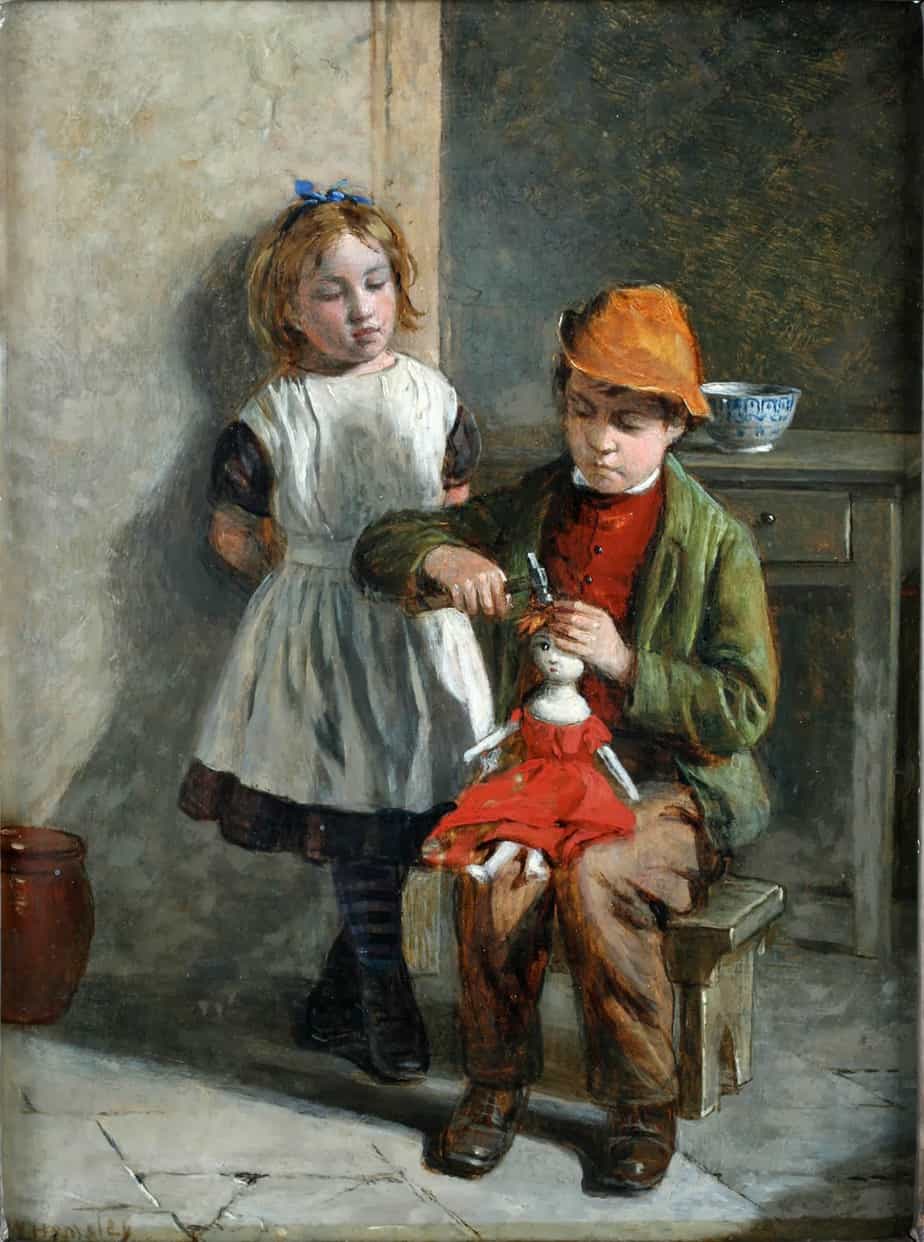
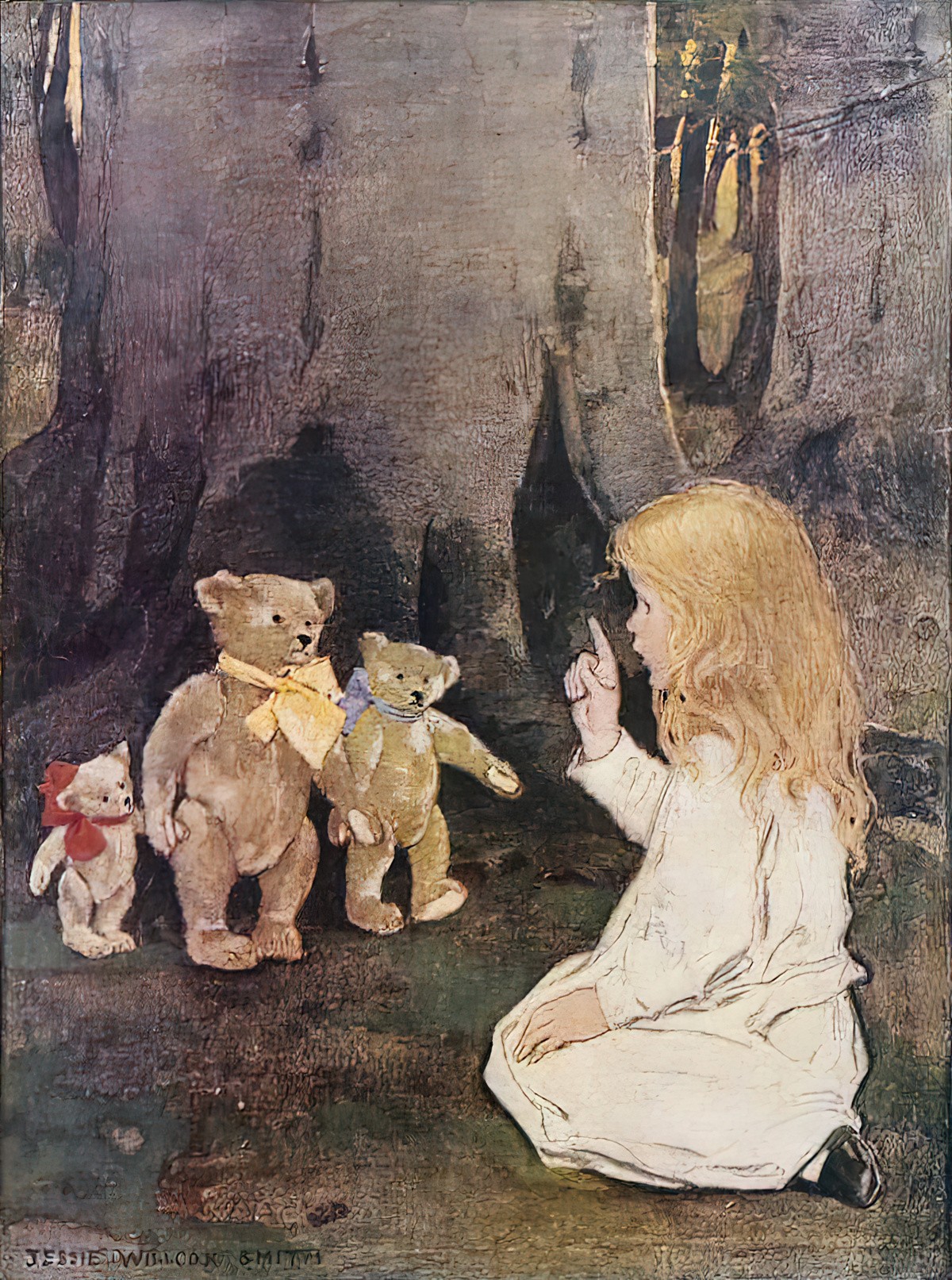
What about Pygmalion stories as they apply to children’s literature? Well, there are many, many children’s stories about talking toys. Toys have a place in certain types of wish fulfilment stories: The wish to have a friend and also the wish to never die, especially when toys are mended, or when they can be re-wound, in the case of a wind-up toy. (The modern version would be having its batteries replaced, if this kind of story were more common today.)
The wish for one’s toys to come to life as friends is a common wish-fulfilment fantasy in children’s literature, and I propose that this is the childhood analogue of the adult Pygmalion fantasy.
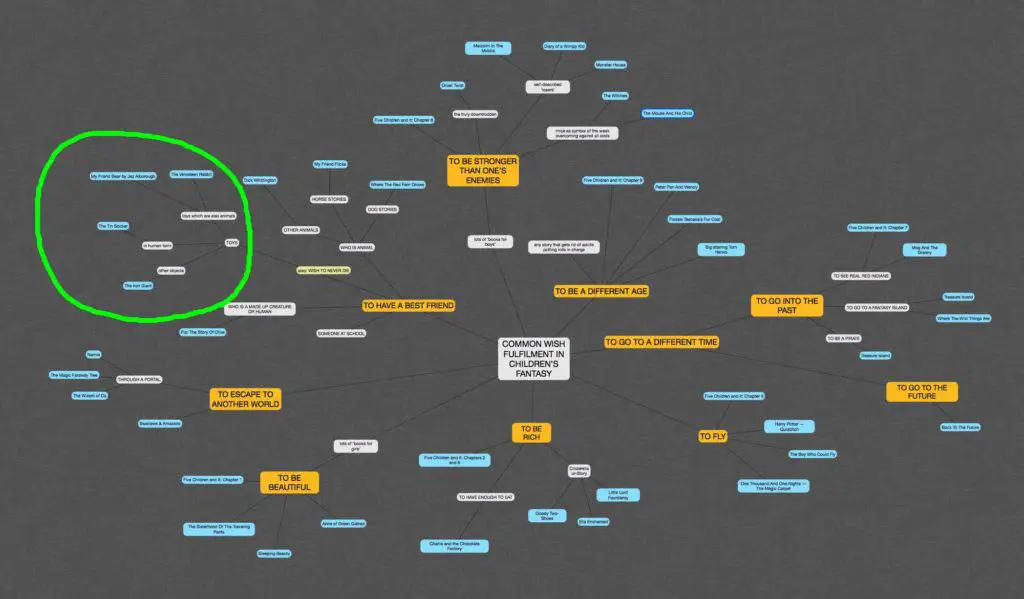
Maria Nikolajeva makes no distinction between the role of talking animals and the role of talking toys in children’s literature. Whatever can be said of animals can also be said of toys. Though the function is the same, Margaret Blount does make a distinction between who tends to tell which kind of story to whom:
Human is what the child wants his toy or pet to be, the substitute friend or brother, like himself but exempt from all the dreary rules attached to childhood and growing up, the eternal confidant or companion, steadfast and unchangeable. Stories about pets that speak are as old as Dick Whittington or the talking horse Falada, but those about toys that ‘come to life’ are most often of the kind that fathers and mothers tell to children in order, as C.S. Lewis mentions in Three Ways of Writing For Children, to give one particular child what it wants. They do not date back much before the Victorian Age and the time when childhood began to be considered in isolation and regarded in sentimental or romantic fashion.
Animal Land, Margaret Blount
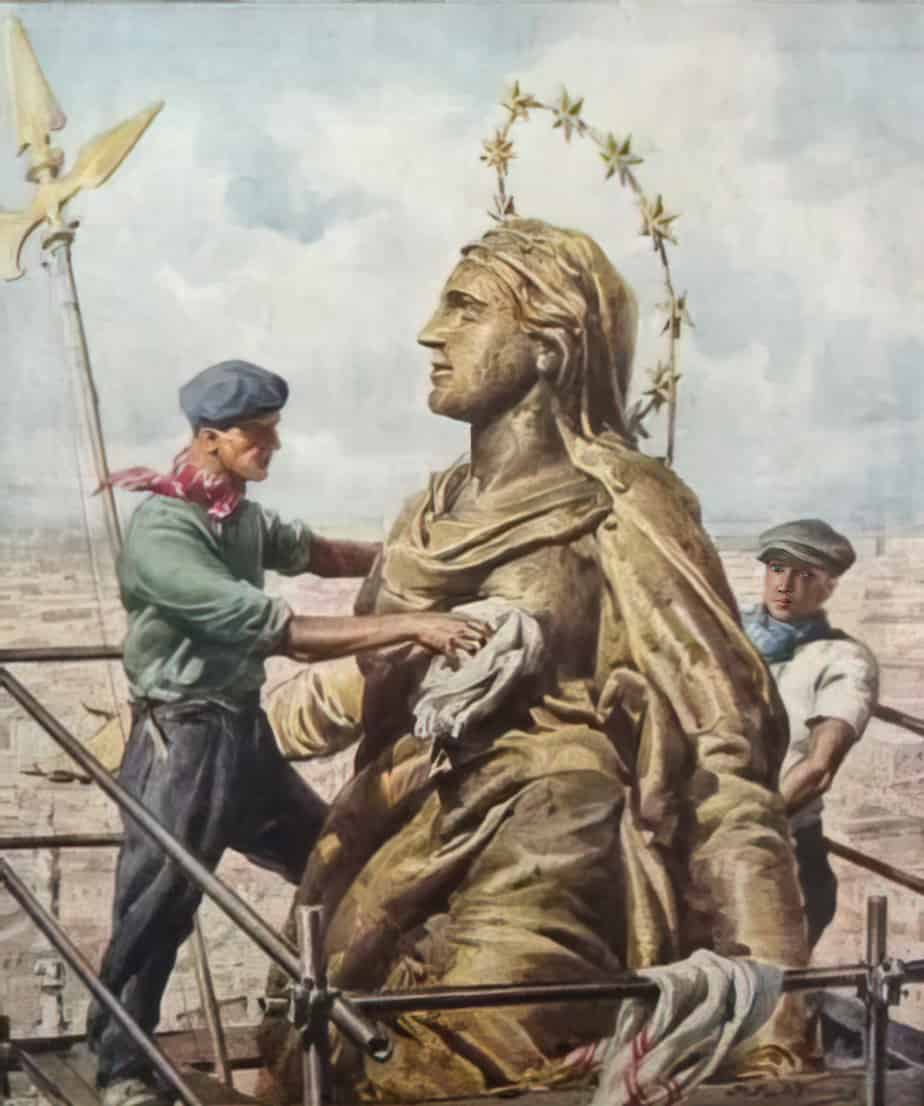
TALKING TOYS IN CHILDREN’S LITERATURE
- Miniature people (who often have the bodies of mice), supernatural creatures and animated objects have similar roles throughout literature.
- Imaginary friends can go into the same category.
- Stories with talking toys therefore are quite often ‘sentimental’ and ‘romantic’.
- Talking animals are never killed — it would be too much like murder. Especially when toys are in the shape of animals, the author might as well be writing about an animal. That’s how much readers can empathise.
- There is usually no eating and drinking when it comes to talking toys and pets — it’s a bit uncomfortable that humans eat creatures without conscience.
- Characters who are toys often have delightful predictability, and sometimes mechanical behaviour which can be used to humorous effect (especially if they wind up at the back).
- Some toys talk only under certain conditions.
- Sometimes only their owner can hear them.
- Toys are made to be loved, yet what they seem to do is endure hardship with patience and steadfastness e.g. The Little Wooden Horse, who is sneered at for being simply and plainly made. (The Ugly Duckling story but in toy form.) Toys make good aesthetes since they don’t even need to eat. (See above)
- Mark Haddon has said that ‘Ultimately, there is no narrative without death‘. It seems as difficult to write about toys without saying what happened to them as it is to write about humans without mentioning death. (The town dump in The Mouse and His Child, ‘a big grim box’ for Leotard and the Ark etc.
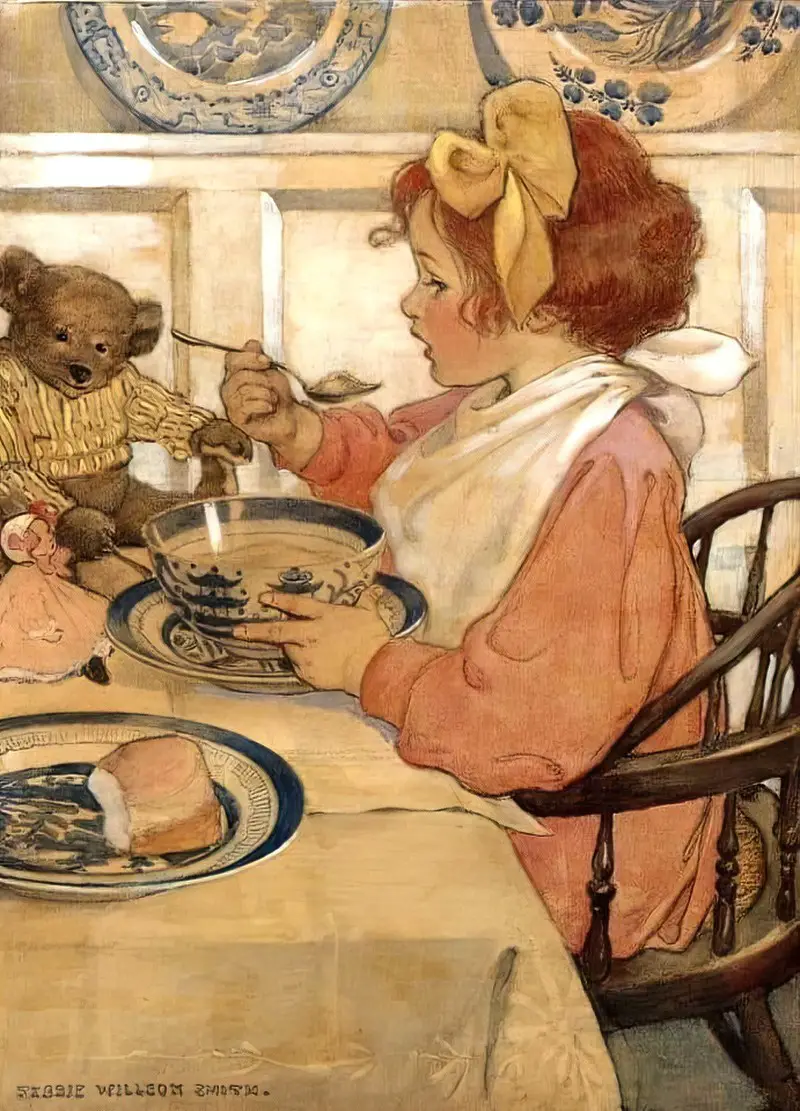
TALKING TOYS IN THE 1800S
THE LITTLE TIN SOLDIER (1846)
It is not until 1846 that you get a story like The Little (Brave) Tin Soldier; and in nurseries, the gradual additions of strange creatures to the more conventional ‘human’ families — toy animals, the Golliwog and that indispensable piece of nursery furniture, the enduring Teddy Bear. Adults made the toys talk, and they became a child’s companions on magic adventures.
PINNOCHIO (1883)
Though the product is a boy, this is still a Pygmalion story.
MORALITY IN TALKING TOY STORIES OF THE 1800S: TAKE CARE OF YOUR THINGS!
The ideology of toy stories is often that one must take care of one’s things, as if they were almost sentient. I wonder if the throwaway culture of today has contributed to the demise of this kind of morality — it’s no longer necessary to treat your teddy bear with such great respect as an object — when my daughter’s bear went missing it was very sad but I was able to buy an identical one for two dollars at the second hand shop. In fact, the idea that a child should be so attached to their things is almost the antithetical morality of today’s stories. (Including in my own, The Artifacts.)
The children in Sarah Trimmer’s (History Of) The Robins (1786) were taught to feed the birds and be kind to them, as Tom had to be kind to the caddis worms. Talking toys too can give a story a certain moral ring; one must be kind to objects or possessions and the screw is turned when they prove to be human after all. Bad brother breaks his sister’s doll with the excuse that Toys Can’t Feel. Night comes and the toys come to life and of course they can feel and sometimes take a nasty revenge in a place where they are powerful and children are not (Rupert has this experience several times and once with Freudian additions in Mary Tourtel’s Rupert and The Wooden Soldier, 1928. The style is long lasting.) In fact, Toyland becomes a recognisable place for fantasy happenings and sometimes retribution from F. Anstey to Enid Blyton.
Margaret Blount, Animal Land
TALKING TOYS IN THE 1900S
ONLY TOYS BY F. ANSTEY (1903)
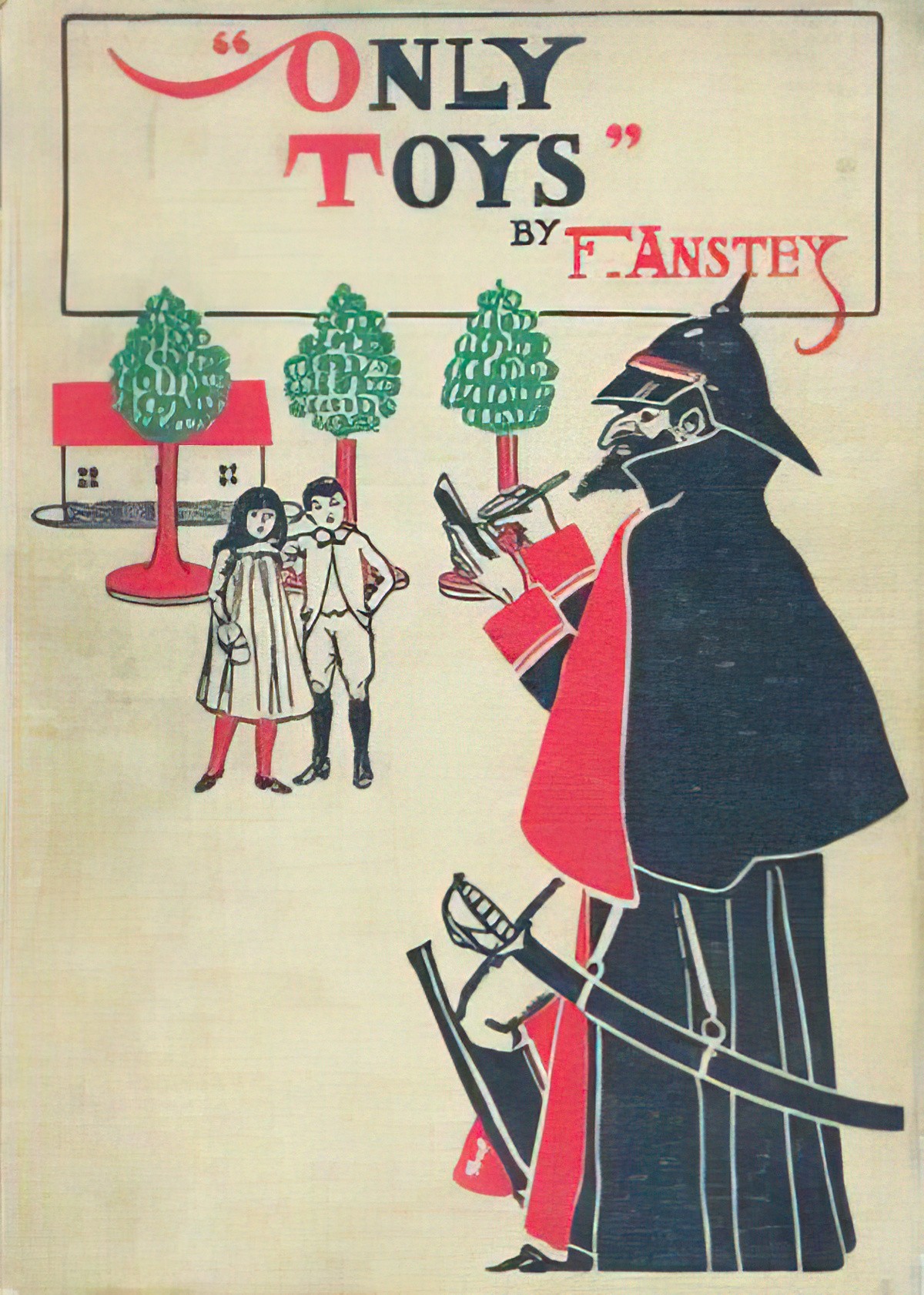
[This story] has a toys’ vengeance theme and more interesting experiences of doll’s house living, which turns out to be as awkward as Hunca Munca and Tom Thumb found it. Torquil and Irene, transported to the place where toys are real, find their own doll’s house a very inconvenient place to be — the food is inedible, the drink not what it seems, the fire won’t burn and the kettle won’t boil. The dolls have a stiff hierarchy as wooden and artificial as themselves. But few toys stories exist without human interaction. Toys have owners as pets do and in Toyland toy and owner meet on equal terms. All animals speak, whether ‘real’, carved or stuffed; it is a place that everyone recognises, with wooden trees and animals out of the Ark, always dreamlike, an after dark playground where nothing goes really wrong — one always wakes in time.
Margaret Blount, Animal Land
RACKETTY-PACKETTY HOUSE BY FRANCES HODGSON-BURNETT (1906)
You may remember in The Little Princess that Sara Crewe has a doll house and she imagines the dolls talk while she’s not there. This lesser-known book for younger children stars those talking dolls, and is told by a fairy narrator. The introduction reads:
Now this is the story about the doll family I liked and the doll family I didn’t. When you read it you are to remember something I am going to tell you: If you think dolls never do anything you don’t see them do, you are very much mistaken. When people are not looking at them they can do anything they choose. They can dance and sing and play on the piano and have all sorts of fun. But they can only move about and talk when people turn their backs and are not looking. If anyone looks, they just stop. Fairies know this and of course Fairies visit in all the dolls’ houses where the dolls are agreeable. They will not associate, though, with dolls who are not nice. They never call or leave their cards at a dolls’ house where the dolls are proud or bad-tempered. They are very particular. If you are conceited or ill-tempered yourself, you will never know a fairy as long as you live.
Queen Crosspatch
I do wonder how many young readers wondered why they weren’t visited by these fairies even though they were on their best behaviour.
THE MAGIC CITY BY E. NESBIT (1910)
Quite the most interesting and unusual Toyland was written about by, as might be expected, E. Nesbit in The Magic City — the only book, as distinct from her short stories, where she deals with talking toys. Nesbit children usually do not need toys — they are too busy having imaginative adventures by other means. Like F. Antsey’s Torquil, they might remark that toys are ‘a babyish pursuit…except when they are exact models of things’. The Magic City, or rather series of cities, is a place that can be entered only by those who have helped to build it with books for bricks; and it is populated by creatures and people that have been put there, or have managed to escape, out of the books from which it is made. H.R. Millar’s drawings give the city that slabby, Babylonian/Aztec look of any structure made of books, ornaments, chessmen and dominoes. The story has that odd, logical but numinous quality shared by The Enchanted Castle, when the children who enter the city find that it is greater inside than out and has a history, prophecies and laws that seem to be older than its creators. That the dragon outside is a toy with a winding key does not make it any less fearsome; but it is still dreamlike — and one never dies in a dream. The lions in the desert that the children encounter are Noah’s Ark lions, but fierce and predatory. These lions are killed, and when dead are found to have turned to wood once more — a dreamlike easing of otherwise intolerable consequences.
Margaret Blount, Animal Land
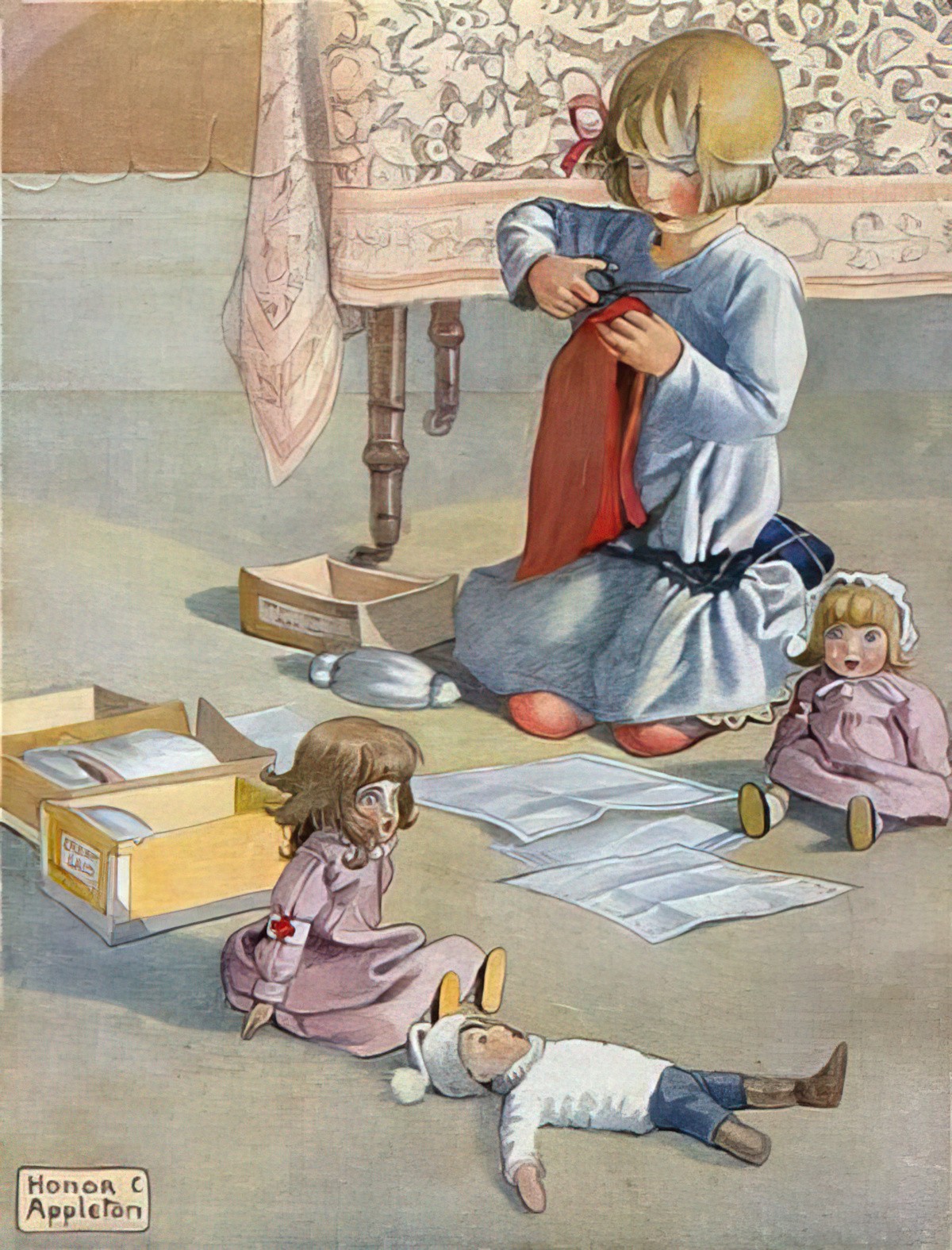
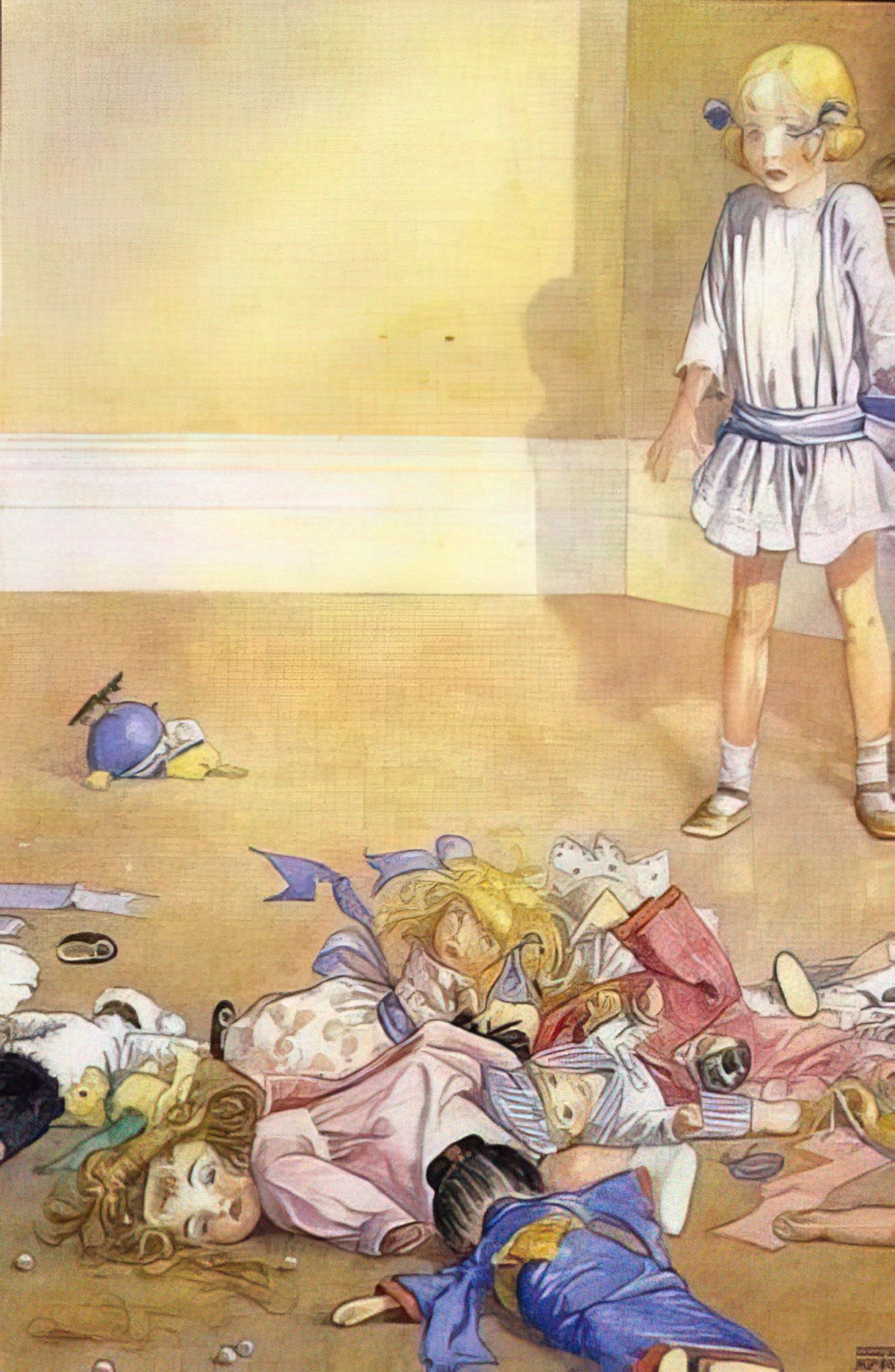
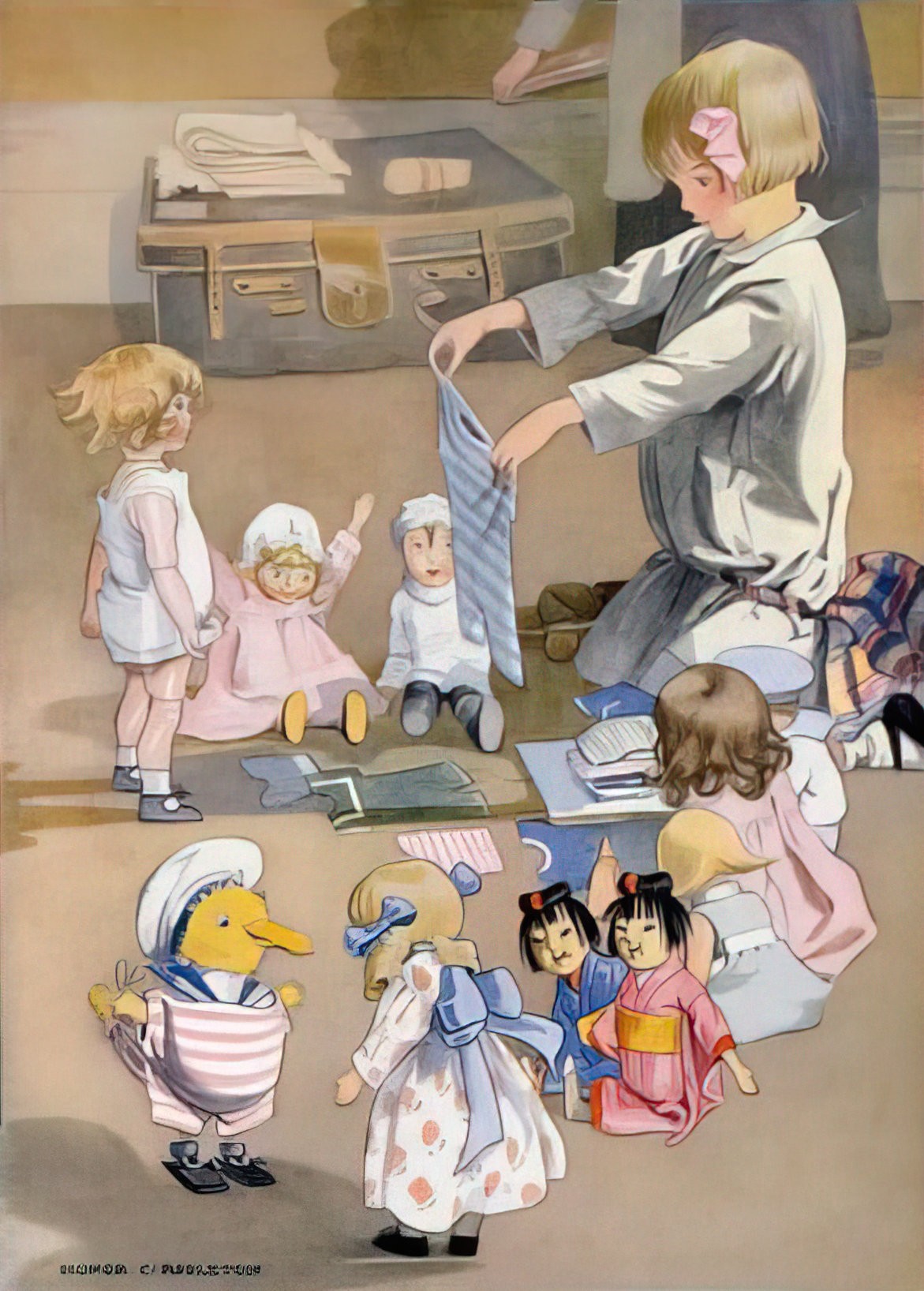
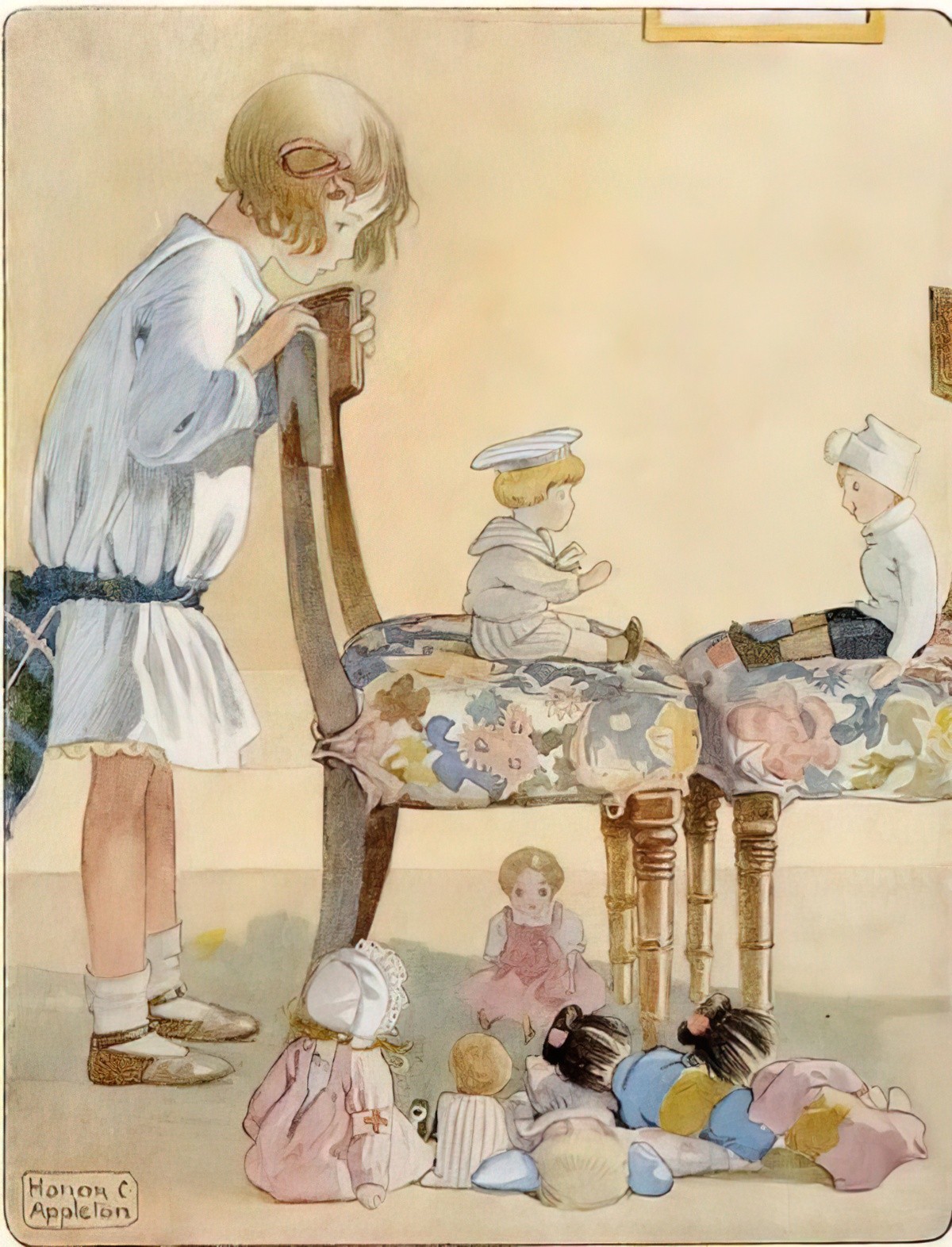
JOSEPHINE AND HER DOLLS (1916)
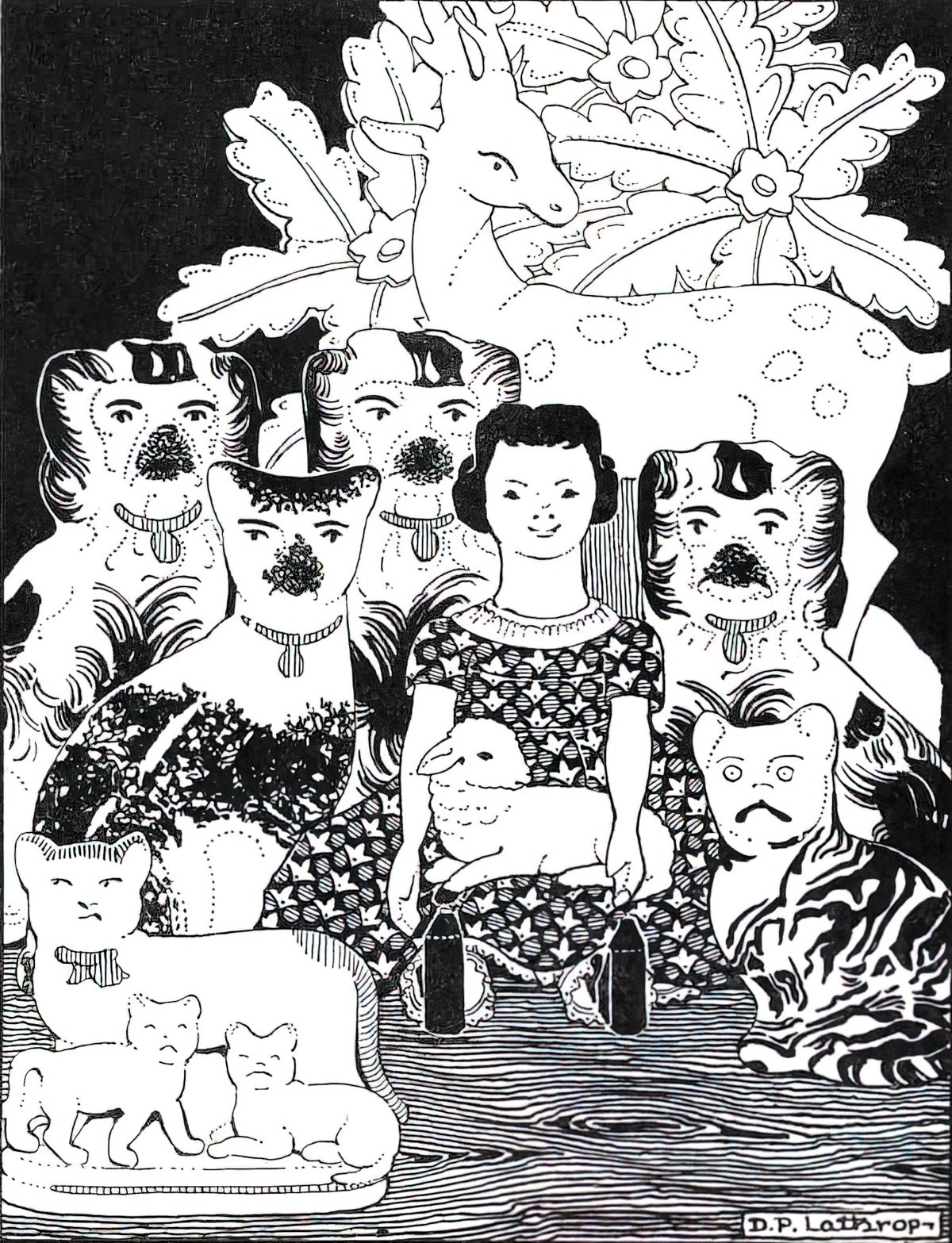
HITTY, HER FIRST HUNDRED YEARS (1929)
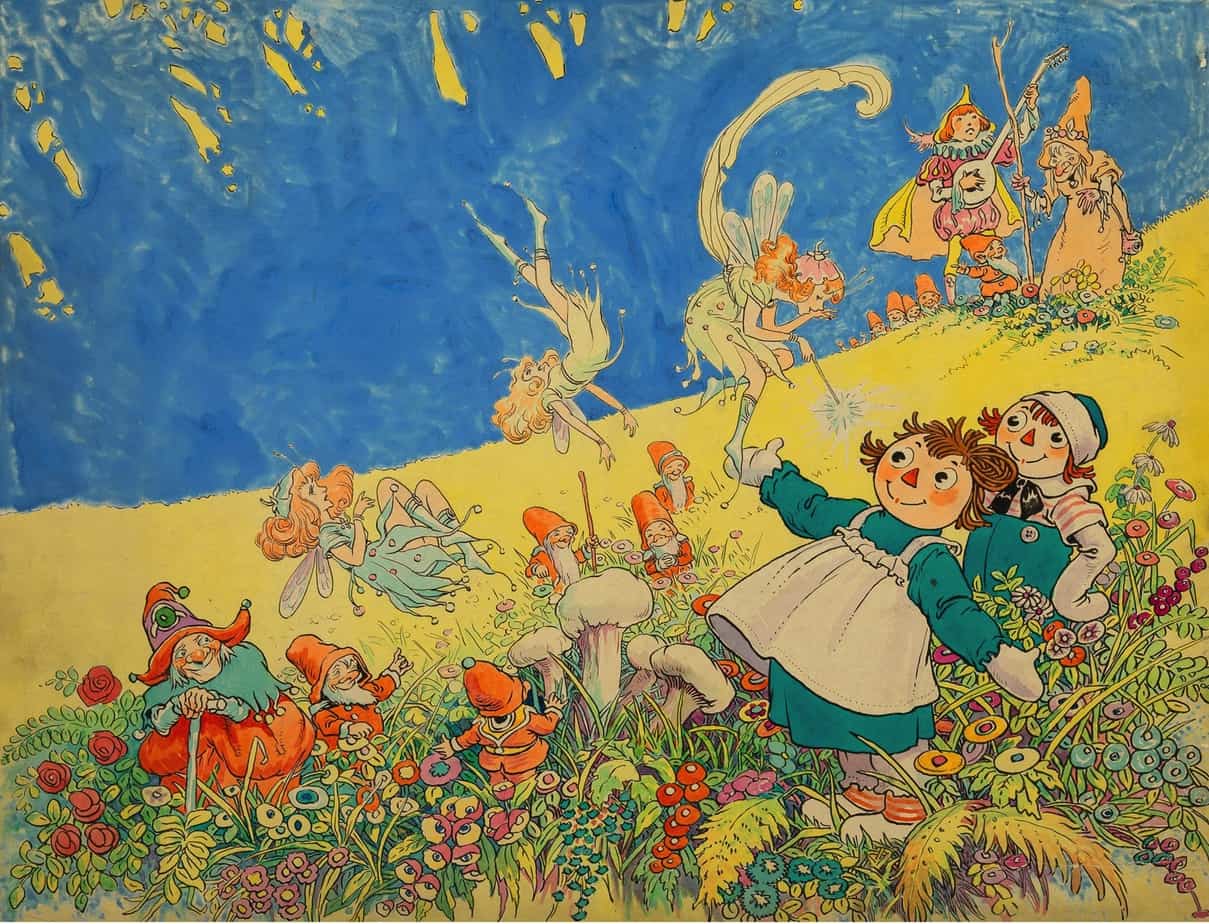
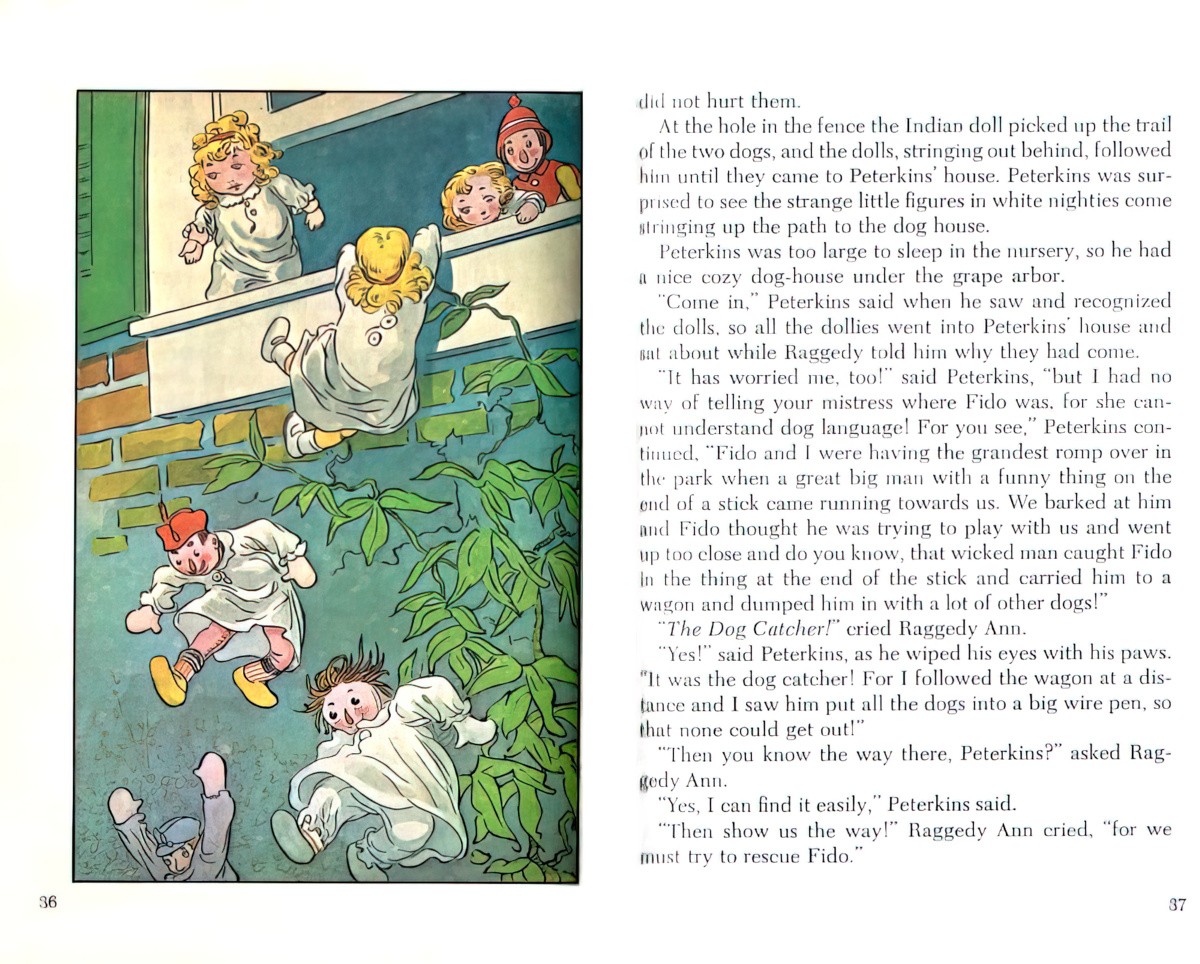
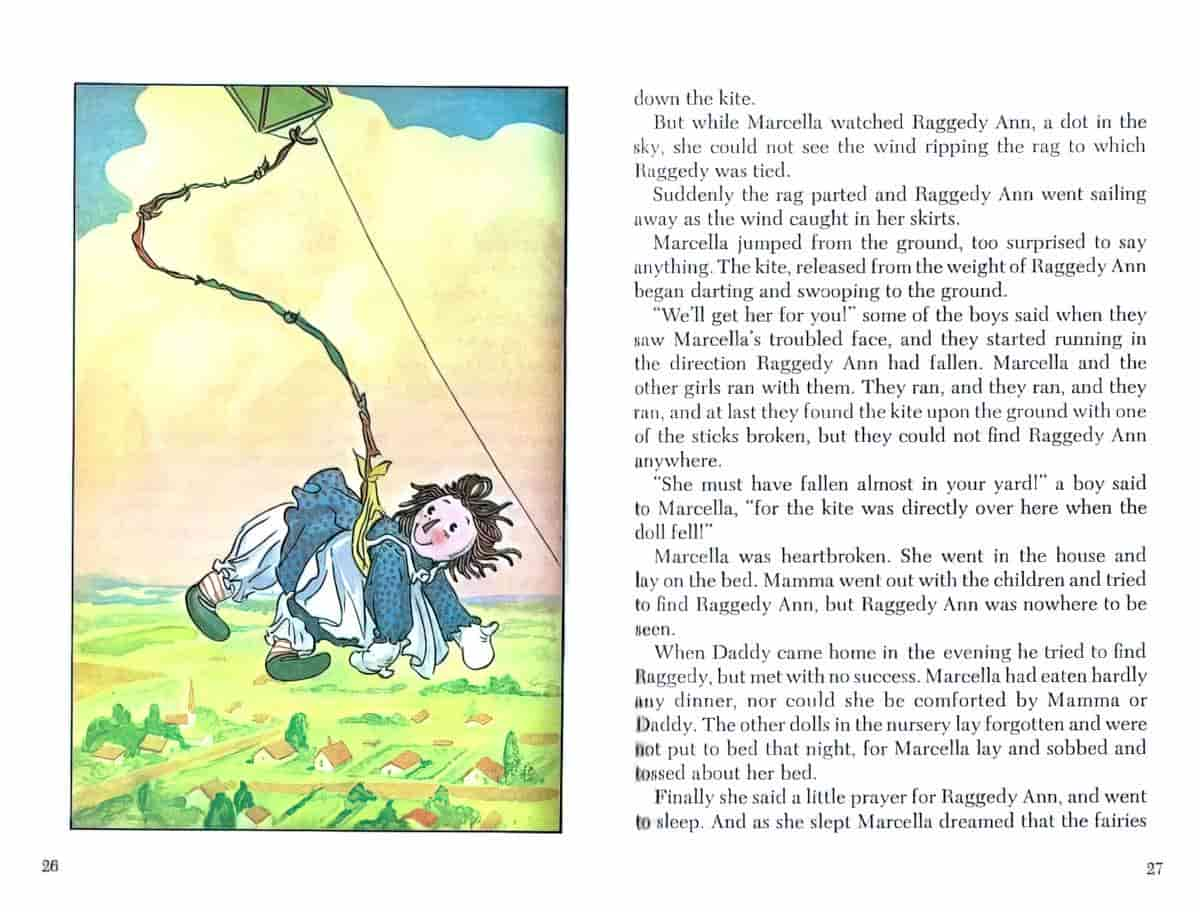
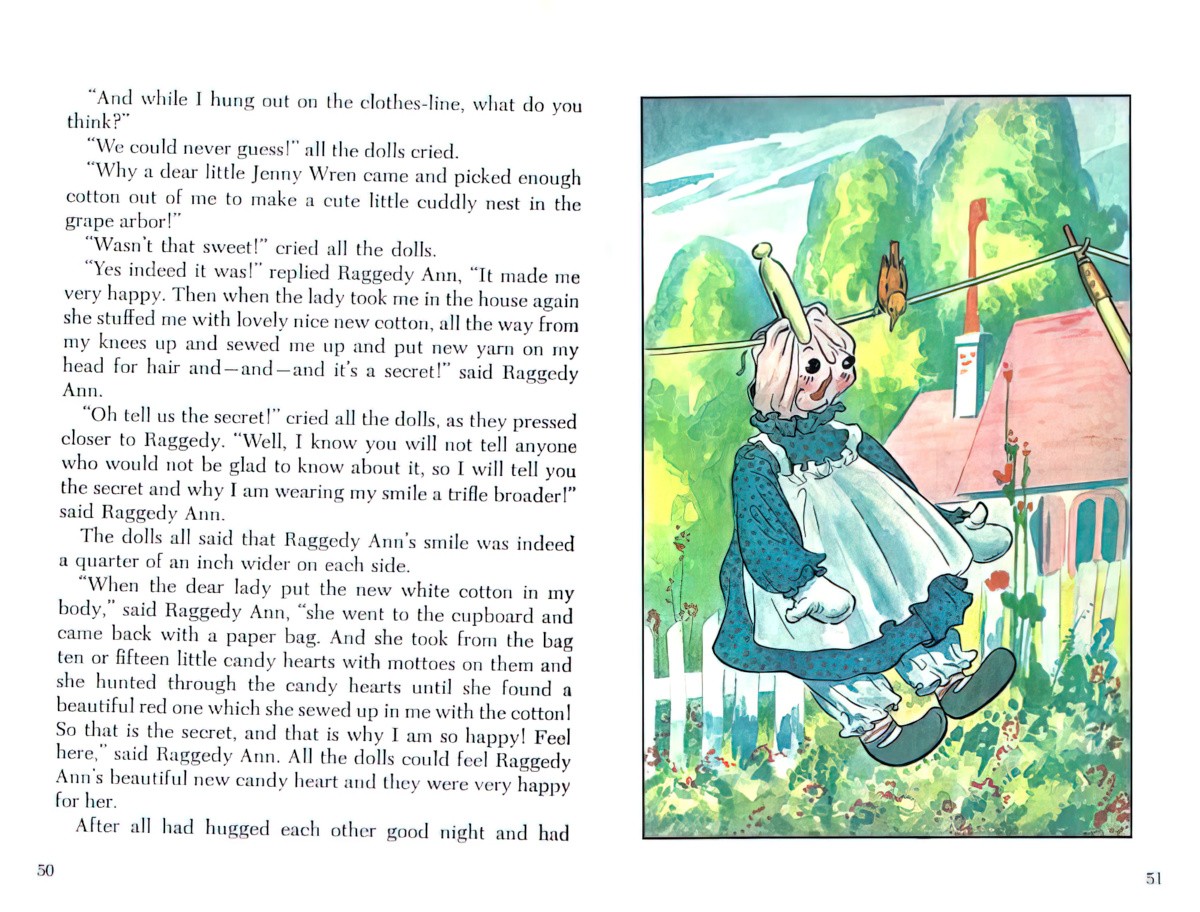
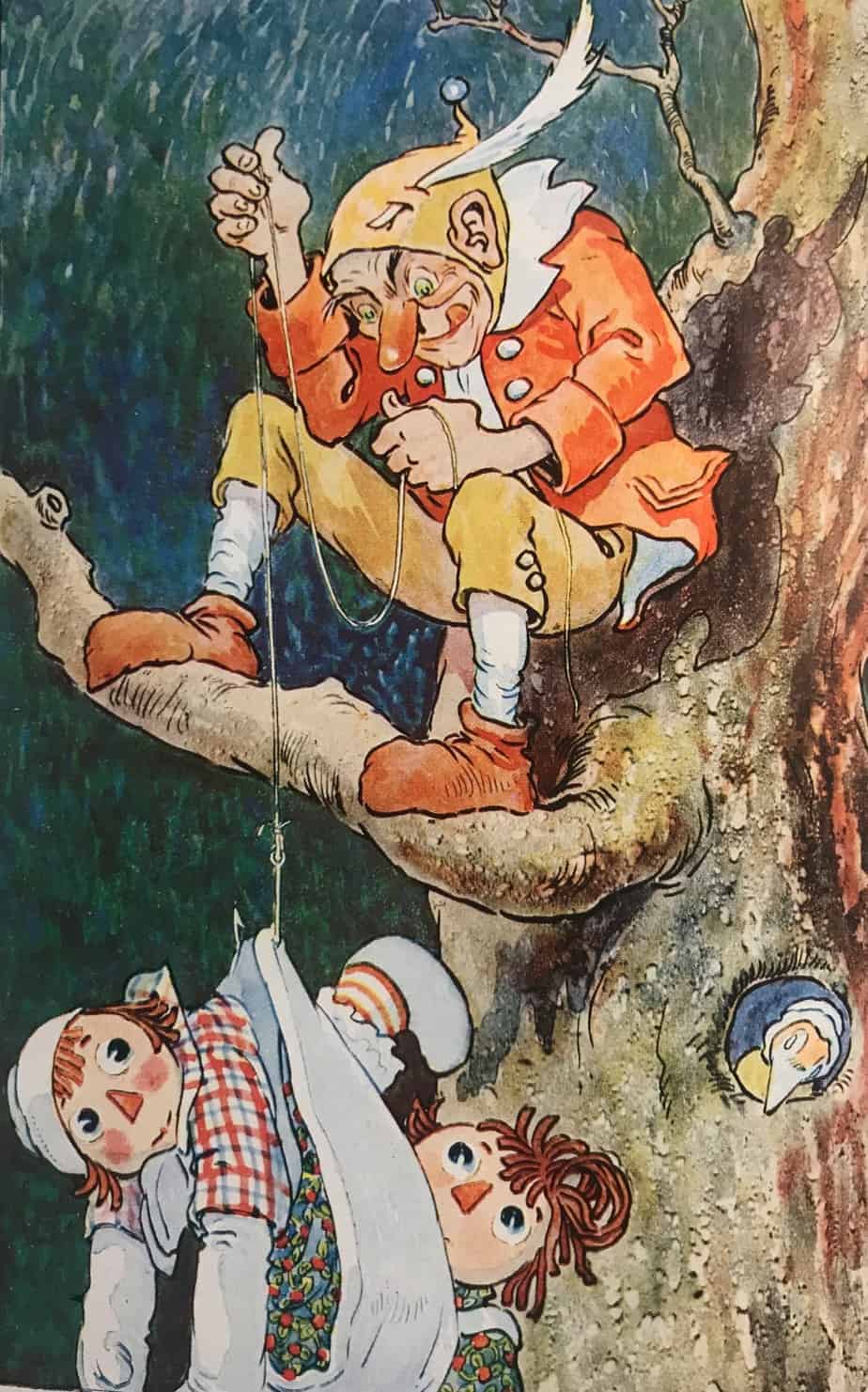
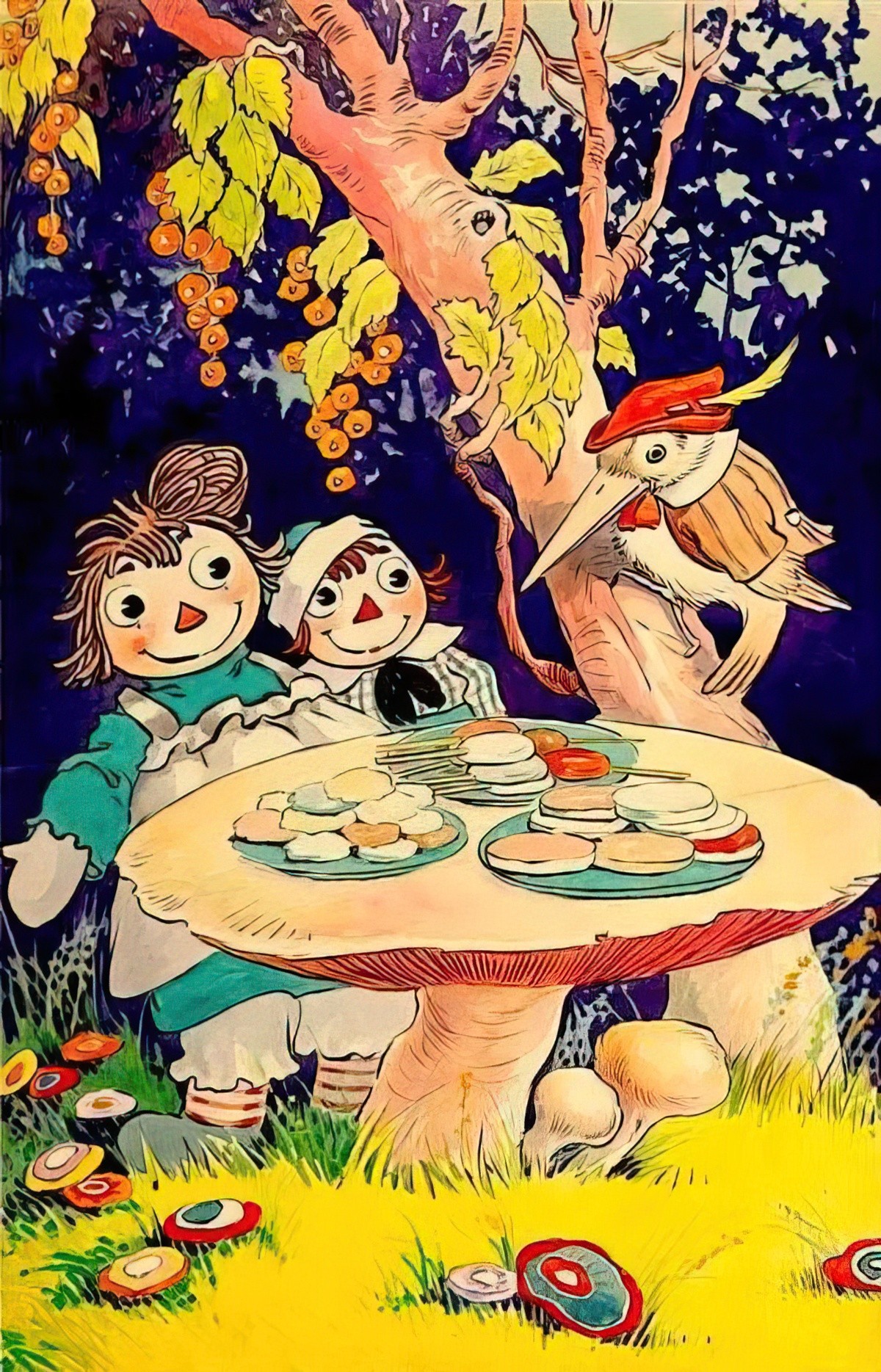
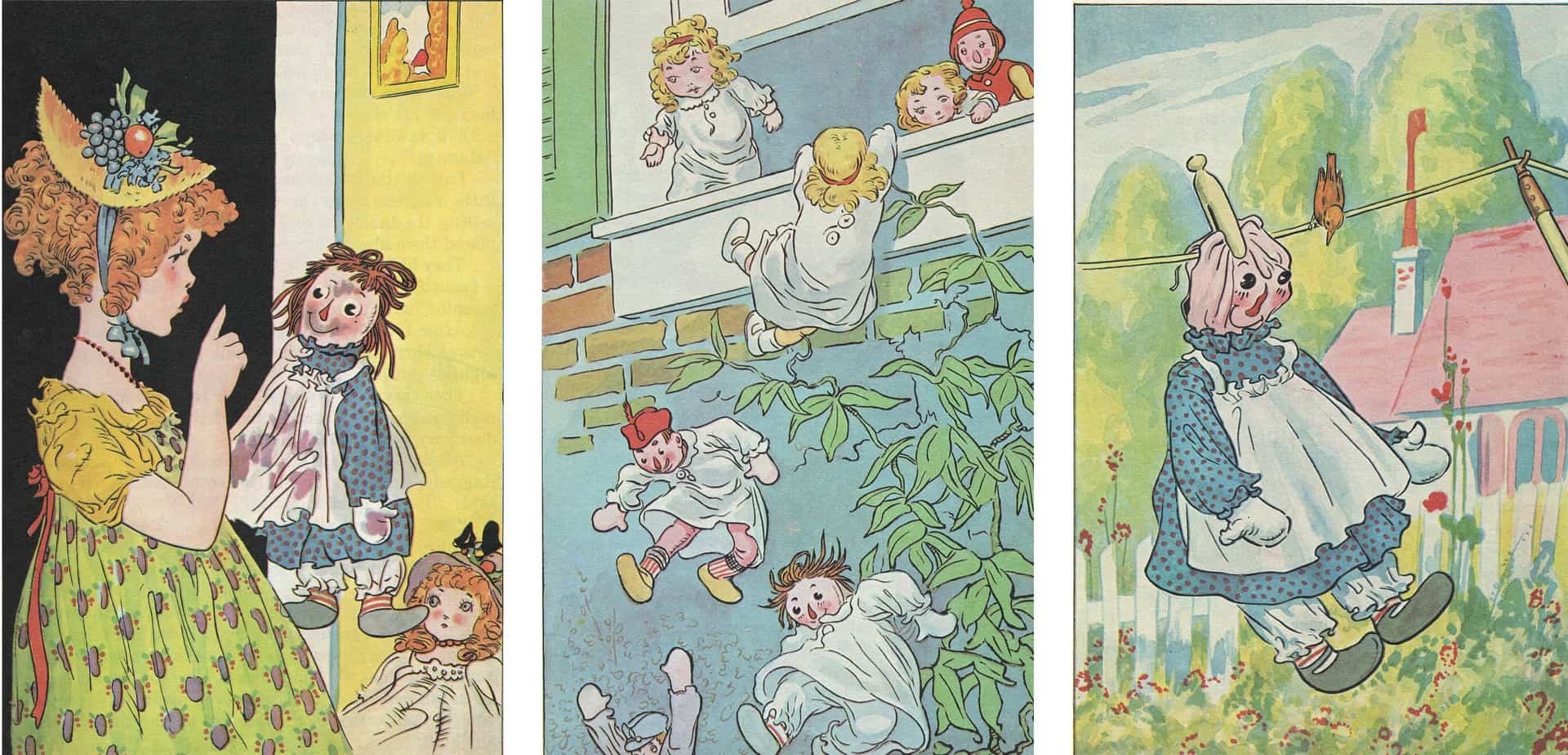
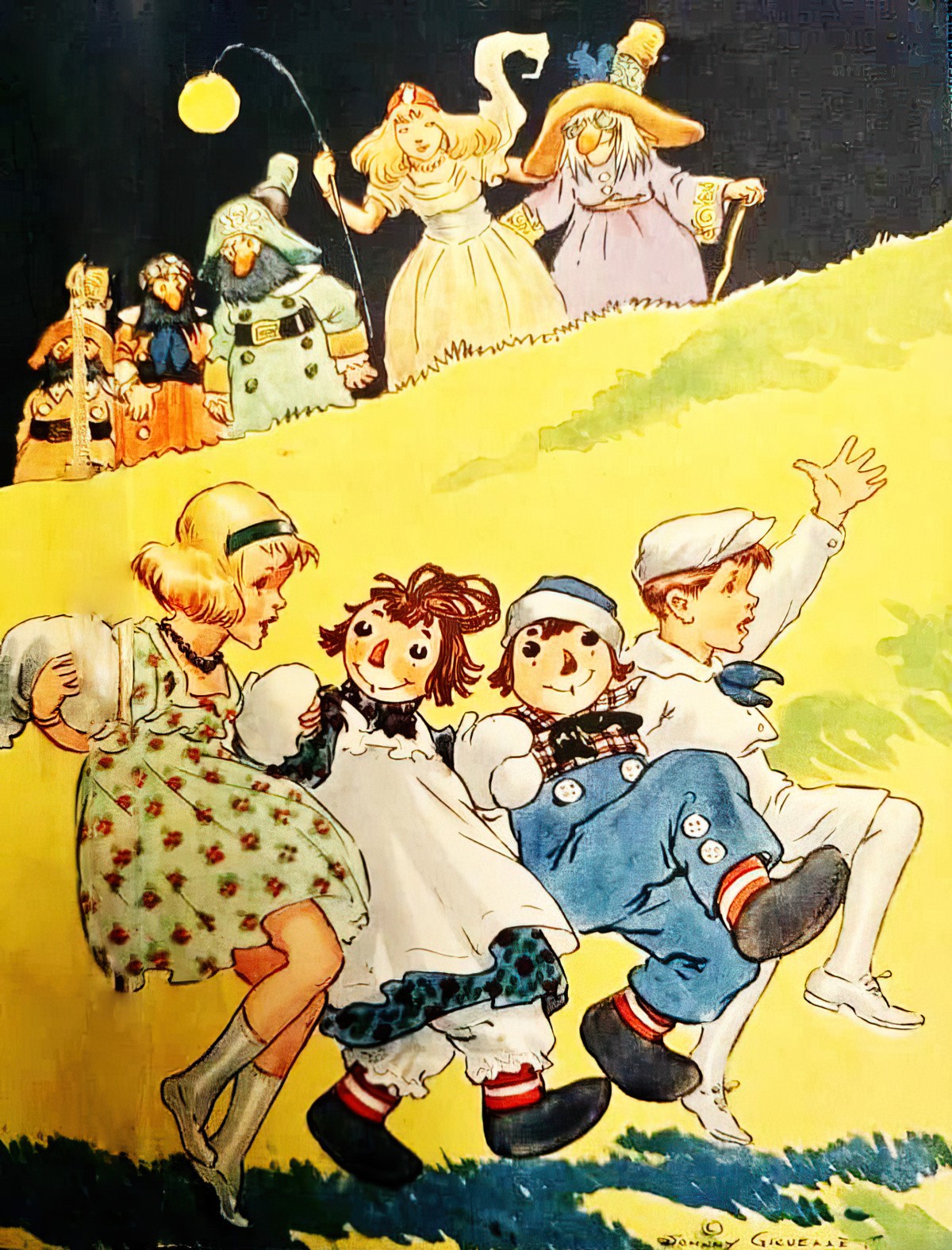
RAGGEDY ANN BY JOHNNY GRUELLE (1960s)
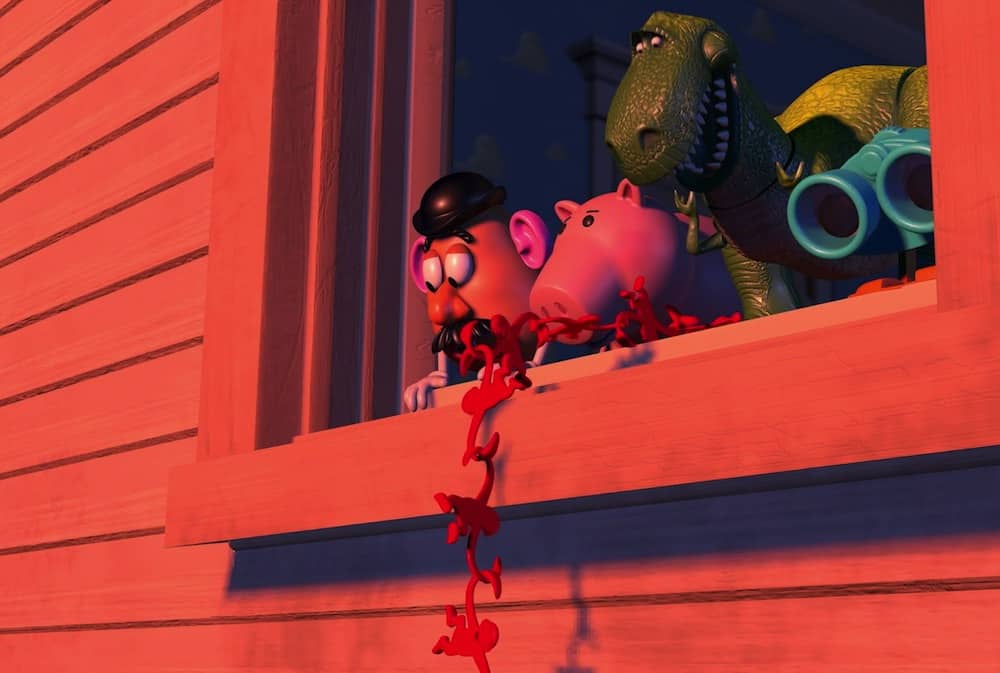
TOY STORY, PIXAR
All of these stories lead up to Pixar’s Toy Story, released 1995 to huge critical acclaim and huge box office earnings.
TALKING BEARS
Christopher Robin enters a world (The Hundred Acre Wood) where his toys can talk and he never has to go back, unlike Paddington/Mary Plain/the Pushmipullyu. Winnie the Pooh was modelled on the toy bear of illustrator Shepherd’s son Graham. The actual bear is quite a bit thinner, though.
A bear character is never inconsiderable; no Teddy bear takes second place in the toy hierarchy. He is always King, the first in a child’s affection. As Pooh progresses his rotundity increases, his legs and arms shorten, his back becomes humped (a rare characteristic only seen in vintage bears and never on modern ones), his head pokes forward as if in deep thought. He is the first famous fictional bear and all the others owe him something; his size, his fondness for honey, ponderous naïveté and occasional flashes of brilliance have left their mark on other lesser bears, real or toy; and there is no question about Pooh’s reality. His adventures in the Forest and Hundred Acre Wood spring as naturally from character as the happenings in any real life.
Margaret Blount, Animal Land
Toys in popular children’s books are great for people in the modern era to make money — not by selling the stories themselves but by making cheap stuffed toys in China and selling those. Winnie-the-Pooh continues to be the most popular teddy bear from literature, helped along by Disney, who actually made a pretty terrible movie out of the character with none of A.A. Milne’s original wit.
Rupert Bear (1920s and 1930s)
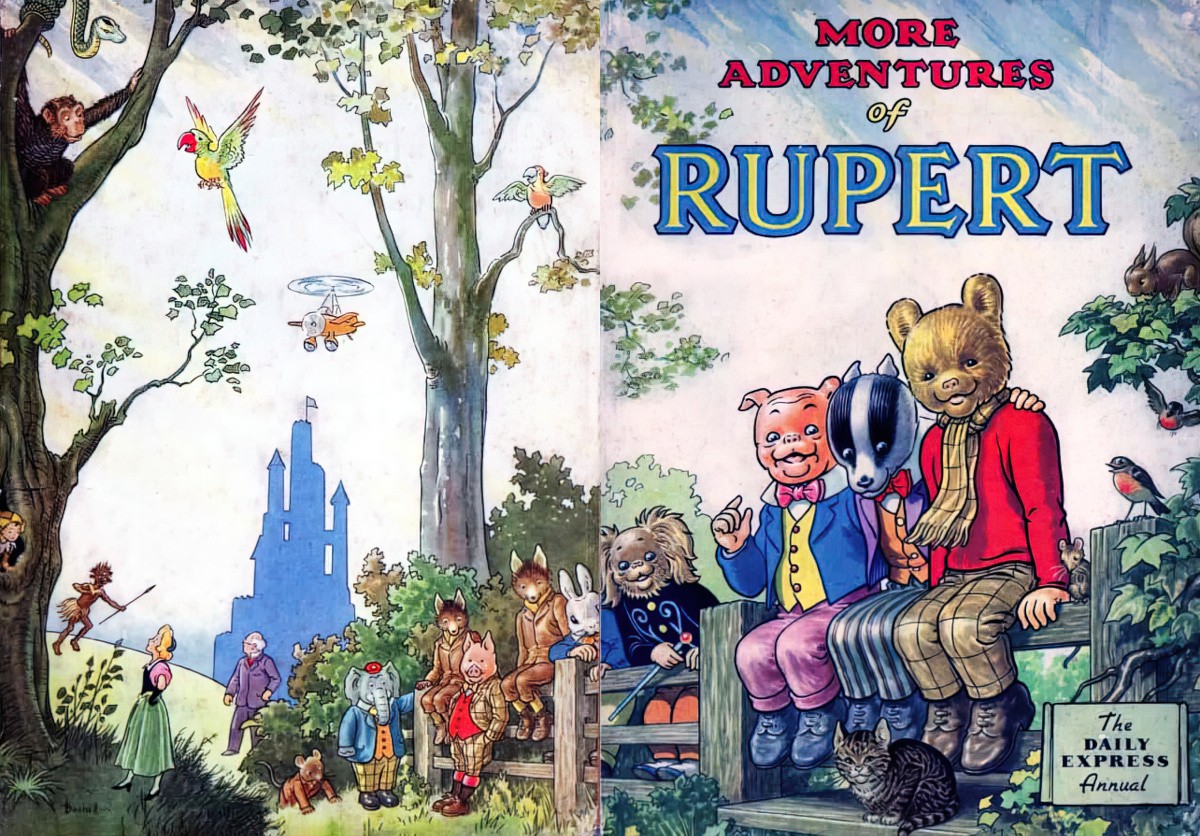
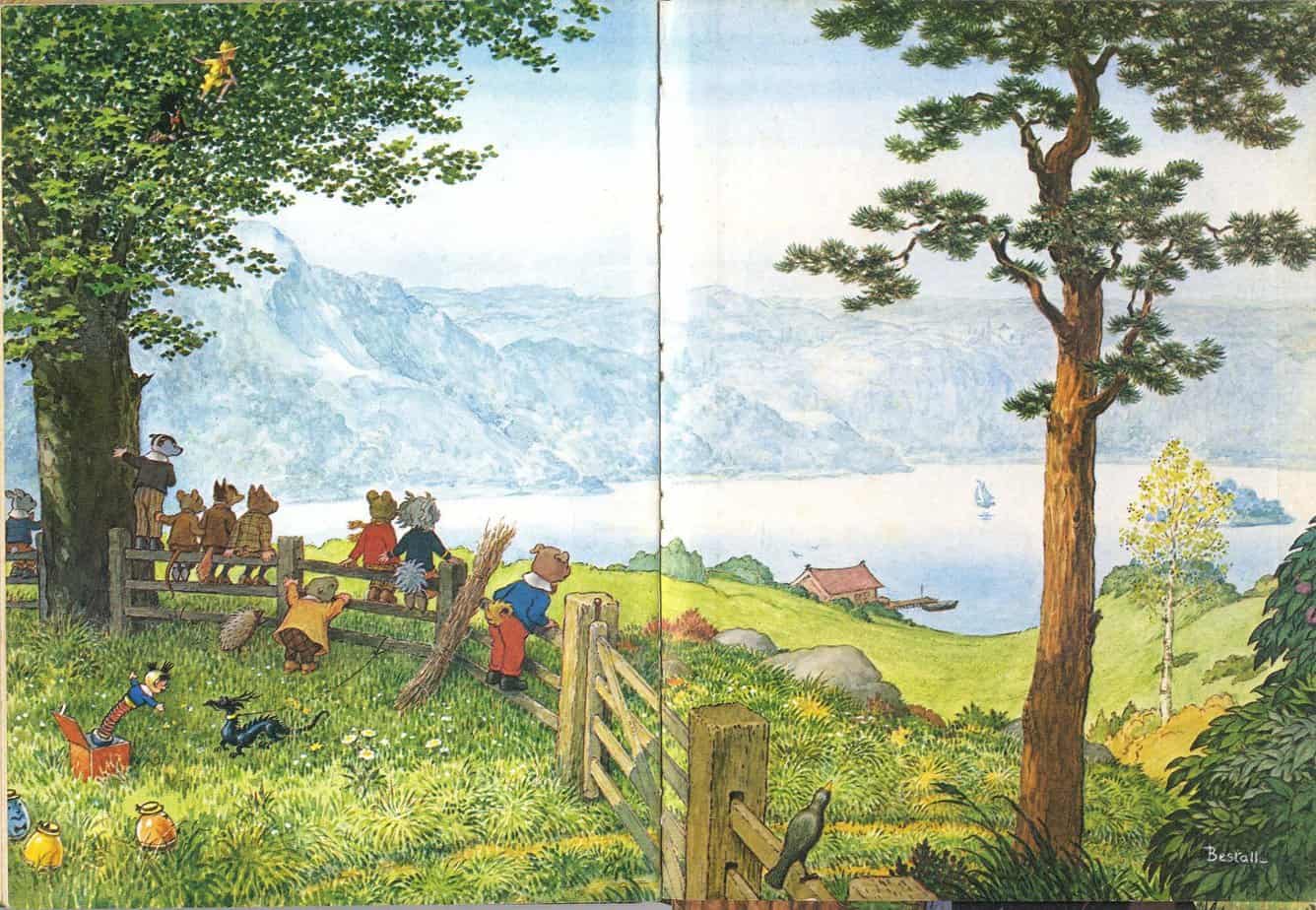
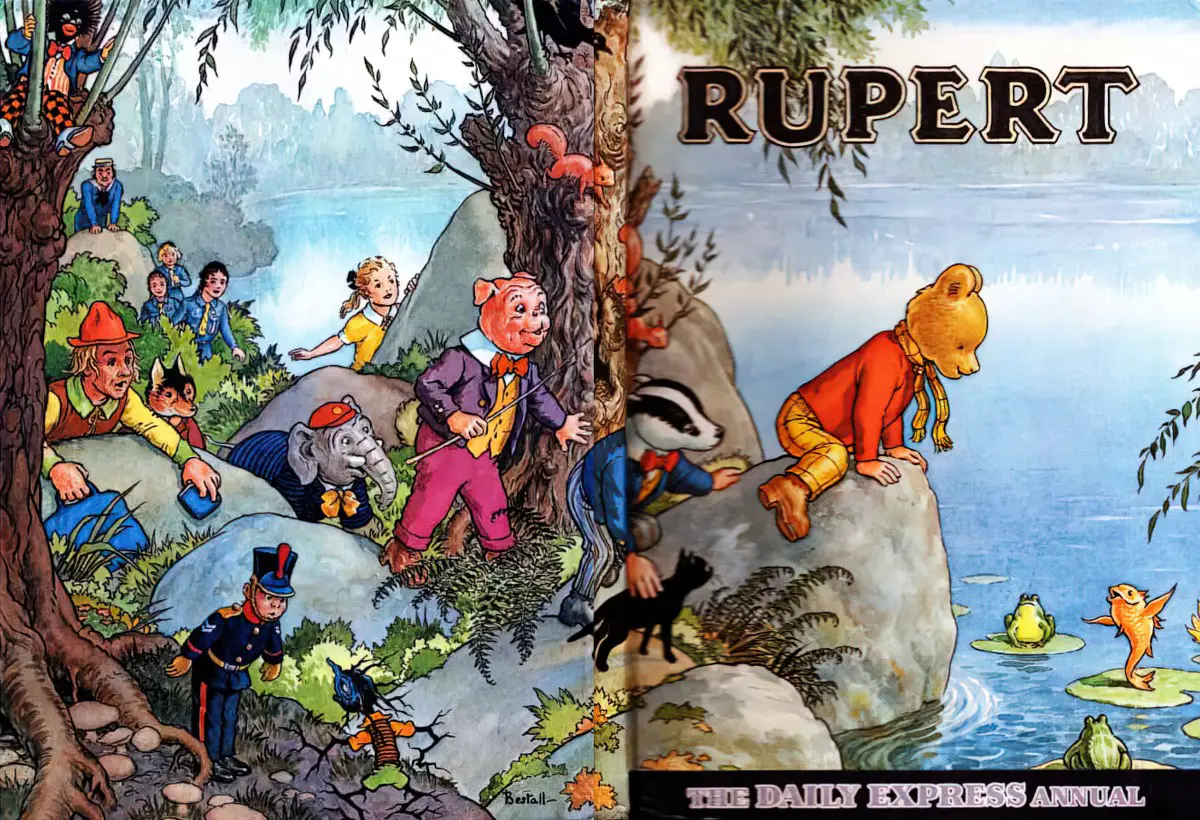
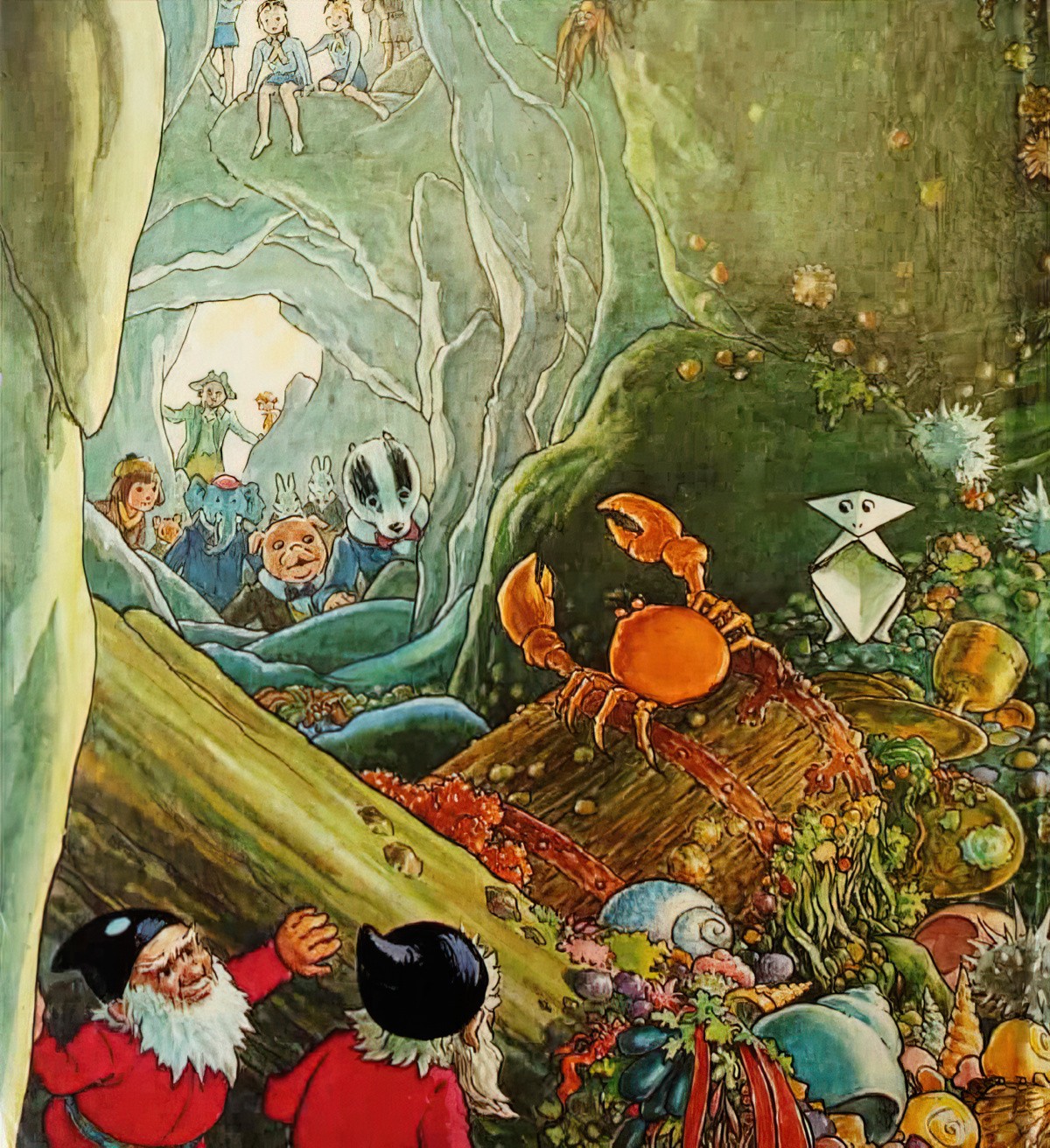
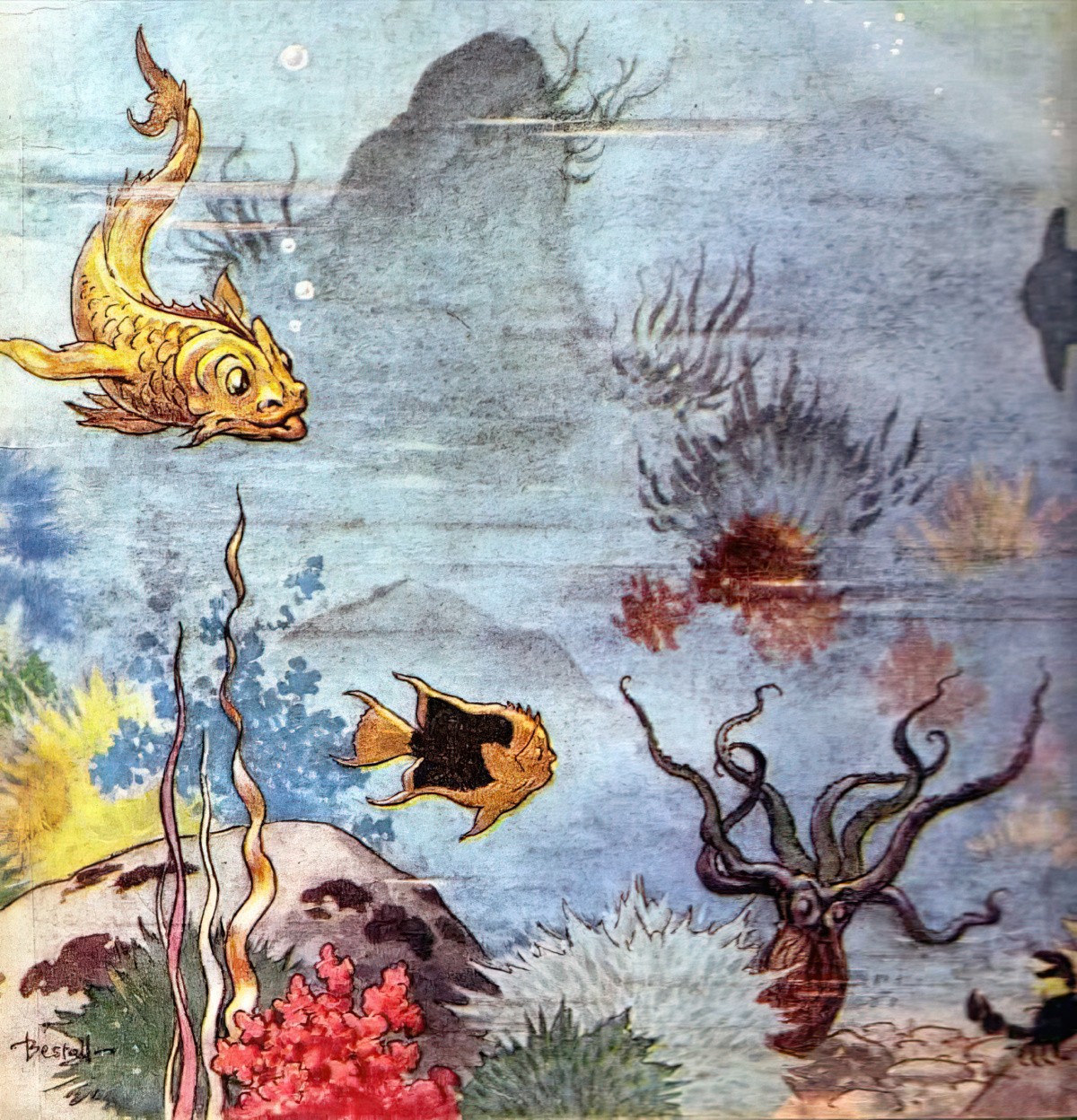
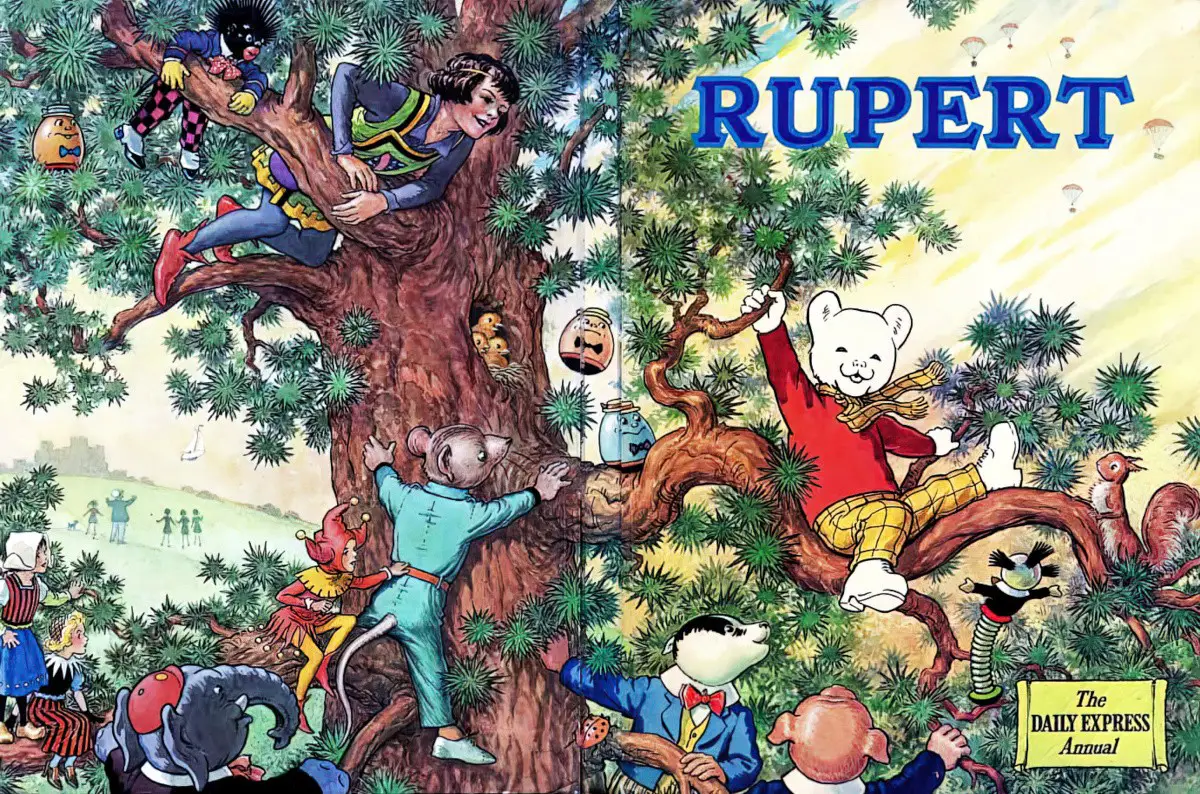
Take a fairy tale from Grimm, one of the more exciting but less grotesque — say, ‘The Golden Goose’ or ‘The Frog Bride‘ or ‘Rumpelstiltskin‘. Add to this some of the glamour of The Arabian Nights, some of the magic and mysterious qualities of the King Arthur cycle and some of its knightly heroism. Add a homely taste of folk tale. Blend these ingredients very smoothly. Dilute the effect by a contemporary setting or framework. Express the result in drawings of beautiful, accurate detail, with no cartoon facetiousness, and then ration the dose to a picture a day, ensuring that addicts will always demand more — and you have the Rupert Bear adventures of the twenties and thirties, and some of the reasons why he enjoyed, and still enjoys, such success and popularity.
Margaret Blount, Animal Land
- The Rupert Bear entry at Wikipedia tells you the full history.
- There is no real reason for this boy to be a boy rather than a human, which makes him an ancestor of modern characters such as Olivia the pig.
- But when he was created it was pretty normal for a child hero to be an animal (a la Pip, Squeak and Wilfrid, the Bruin Boys, Bobby Bear, Teddy Tail).
- The character was created by talented illustrator Mary Tourtel.
- Tourtel tended to give Rupert stories too much plot rather than too little. The stories became simplified over the years.
- The first story was called Little Lost Bear, and was probably inspired by Goldilocks and Red Riding Hood combined. It’s a home-away-home story in which Rupert goes out into the forest, meets a variety of characters then returns home to his mother. (Woods are for getting lost in, in children’s literature.)
- Tourtel was also inspired by The Arabian Nights tales, and Perrault and Dickens.
- Tourtel’s collaborator was her husband, who was an editor. After he died — in 1931 — her stories went downhill, possibly because he acted as a restraining force. (Tourtel was first and foremost an artist, storyteller second. The pictures stopped being self-explanatory, requiring lengthy explanations to help the plot along. Also her drawing skills went downhill, due to failing eyesight.)
- The subsequent Rupert Bear stories are also of this type. “Rupert’s fate was so monotonously terrible that one wondered why he went out at all, and conversely, why his parents never bothered to worry.” — Margaret Blount
- Rupert Bear stories continued to be written by different authors, as were Sexton Blake, Nancy Drew, Sweet Valley High and The Hardy Boys.
- Rupert grew younger and was brought more up to date over the decades. He also passed from animal-boy to boy-in-a-bear’s-body. But he still retains a sort of magical power that can only come from being part human part animal.
- The setting is a place called Nutwood with no towns or cities. It’s populated by other animals and people in about equal numbers. It’s a bit like Narnia in that regard.
- Animal characters tend to be good; people (witches, magicians etc.) tend to be bad. (Apart from wolves and the occasional dragon, of course, who are also bad.)
Pooh has several direct descendants, but the closest is probably Albert, created by Alison Jezard from 1968 onwards.
Illustrator Margaret Gordon even makes him look like Winnie.
TEDDY ROBINSON (1955 onwards)
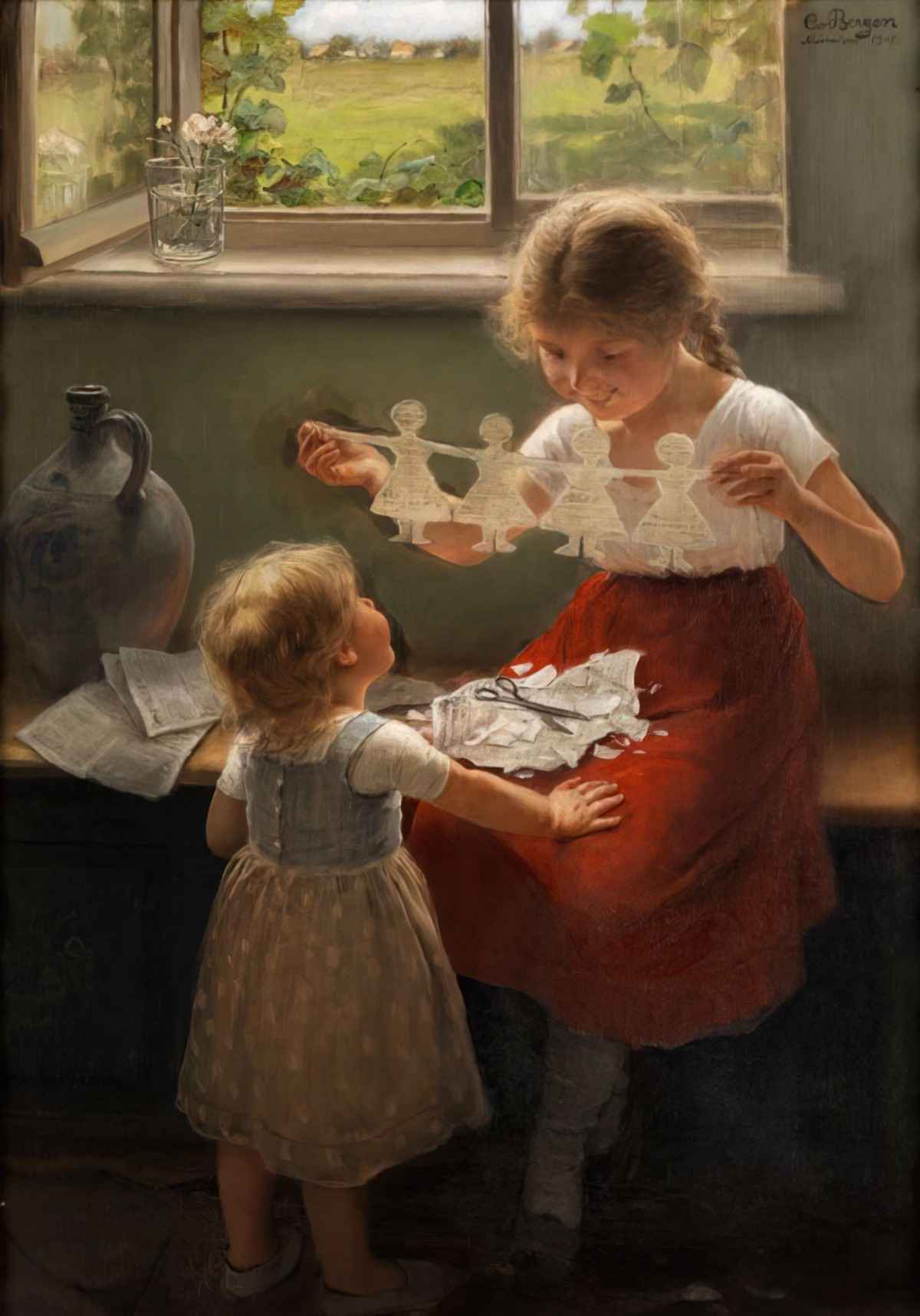
Teddy Robinson’s life is limited to that of his owner Deborah, and he lives in the real world of ‘I said to Teddy and he said to me’, or of Christopher Robin’s Binker, ‘I have to do it for him.’ He moves when Deborah moves and stays where Deborah puts him. His adventures are those of a toy who has thoughts and makes remarks, but is quite unable to move or initiate action. To Deborah he is a child, bear and friend. […] In Deborah’s absence, Teddy Robinson can talk to blackbird, snail, tortoise and kitten; and to Deborah he makes short, simple, acquiescent remarks. Each loves the other wholeheartedly and their lives are totally shared — in many ways Teddy Robinson is the most ‘natural’ bear of all. His personality reflects Deborah’s in the ageless way of well-loved toys, and his adventures are those of getting lose, left behind (on a sandcastle) and forgotten (in a tool shed), placed for sale in a shop window, thrown into a tree by ‘a boy who ran round the garden shooting at people who weren’t there until they were all dead, bouncing on a piano while it is being thumpingly played at a party, playing the games that one insists on one’s toys playing too, being turned into pirate or Indian, or sent to the toys’ hospital.
Margaret Blount
Some of these adventures may remind you of more contemporary books. For example, Shirley Hughes uses the ‘gets lost and winds up for sale’ in her story Dogger.
TALKING TOYS IN THE 21st CENTURY
TALKING TOY OR IMAGINARY FRIEND?
There are still plenty of talking animals in picture books — take Ian Falconer’s Olivia series, for instance. But modern stories don’t tend to be talking pets and toys — they are just animals that talk, no more questions asked. There are plenty of good reasons for depicting people as animals in picture books, especially.
Also common in modern children’s literature are imaginary friends, or if not friends, creatures who stick around for a short time then depart.
- The Lost Thing by Shaun Tan (2000)
- The Adventures of Beekle: The Unimaginary Friend by Dan Santat (2014)
- Crenshaw by Katherine Applegate (2015)
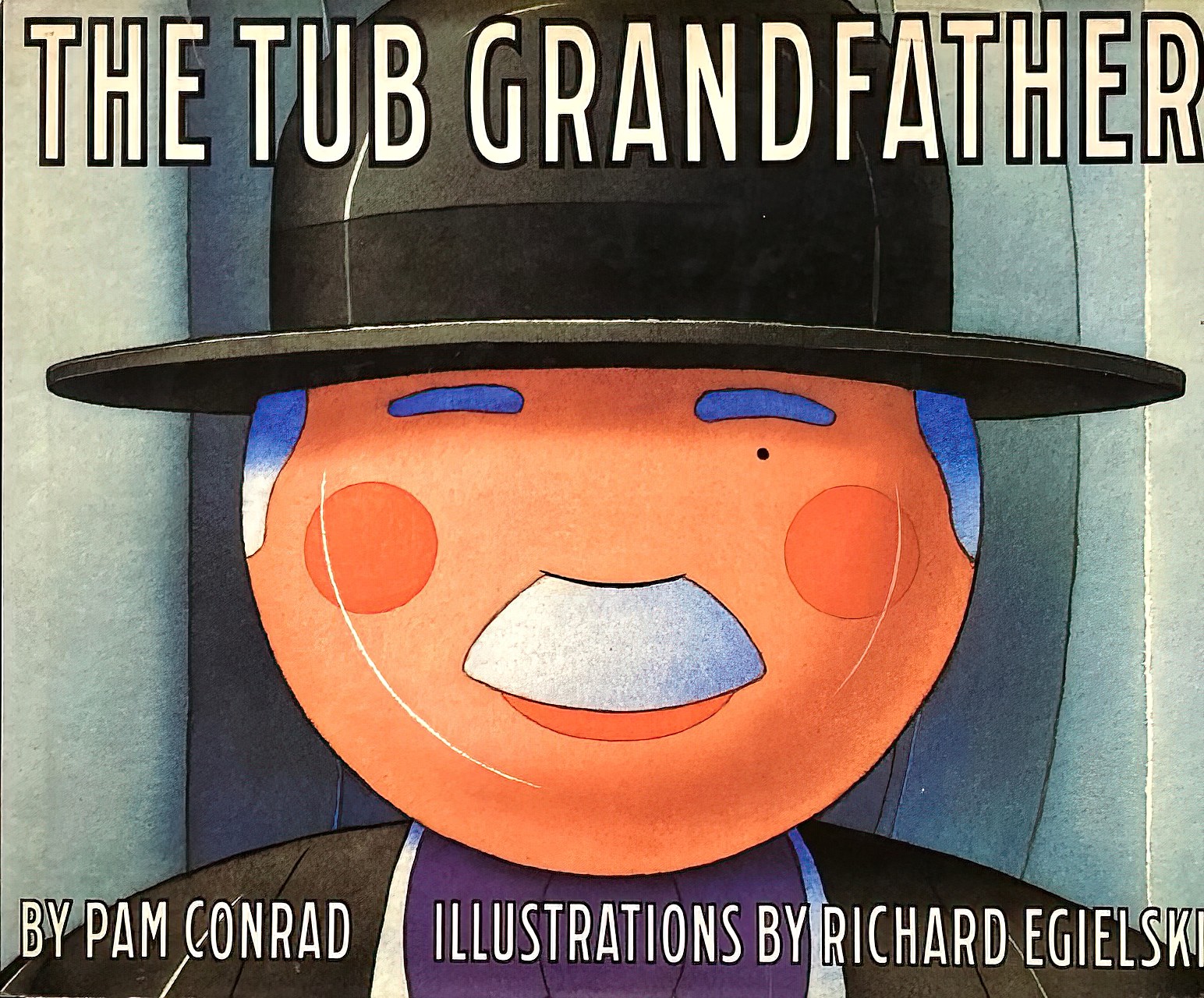
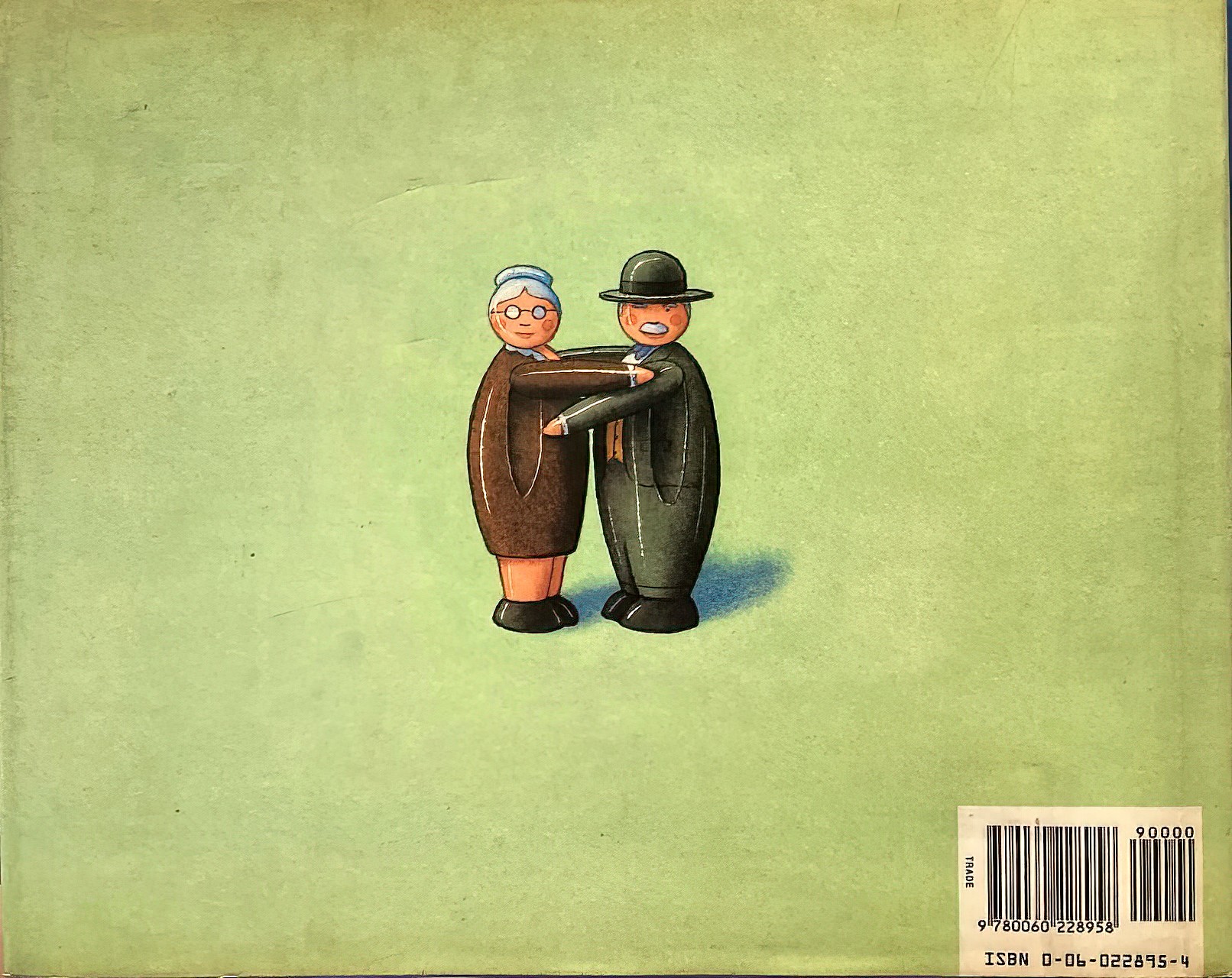
Part of a series by Pam Conrad about wooden people.
PYGMALION AND MODERN JOURNALISM
After the 2016 American Election, with my feeds full of Trump news interspersed with the odd grim images from my earthquake wracked hometown, I was glad to come across a positive article for a change — a biographical piece on a woman called Margaret Hamilton: The pioneering software engineer who coded humans to the moon. I’m going to spend the next four years reading about women and people of colour, I had already decided.
So I read the article and soon came across two full paragraphs not on Margaret herself but Professor Lorenz, the man behind the woman:
Professor Lorenz was one of the people who most inspired Hamilton throughout her life. He taught her a lot about software and gave her freedom to experiment with new ways of doing things.
Hamilton said: “Lorenz loved working with his computer and he would share with me his computer-related experiences and what he had learned from them, for which I was most grateful. Known as a genius by his colleagues, his humility stood out and he was one of the nicest people I have ever known.”
This seems fine, right? I’m sure Professor Lorenz was indeed a great mentor.
That said, when was the last time you read a biographical piece about a man with the achievements of Margaret Hamilton, wherein not the man himself is called a ‘genius’, but rather the wo/man behind the man.
Margaret is rendered passive here. Professor Lorenz gave her freedom.
This is something that regularly happens to women. Her agency is diminished. She is instead the product of a man.
I’m aware that much of that is quoted from Margaret herself, who sounds like she may be prone to typically feminine self-deprecation.
Mind that kind of writing which minimises a woman’s achievements while elevating the men in her periphery.
Another example is Hypatia.
Hypatia (c.355–415) was the first woman known to have taught mathematics. Her father Theon was a famous mathematician in Alexandria who wrote commentaries on Euclid’s Elements and works by Ptolemy. Theon taught his daughter math and astronomy, then sent her to Athens to study the teachings of Plato and Aristotle. Father and daughter collaborated on several commentaries, but Hypatia also wrote commentaries of her own and lectured on math, astronomy, and philosophy. Sadly, she died at the hands of a mob of Christian zealots.
Mental Floss
In sum, when writing about high-achieving women, be careful not to elevate the men around her in a way that actually overshadows the woman you’re aiming to highlight, even if you’ve found some self-deprecating quotes from the woman herself.
When reading about high-achieving women, keep an eye out for this almost invisible marginalisation and see it for what it is: a very long history of sexism, in which we cannot accept high-achieving women without attributing their successes to that of men.
Related to the Pygmalion principle of writing female biographies is the tendency to talk about the men and children in their lives more than talking about the woman herself:
Emilie Du Chatelet (1706–1749) was born in Paris in a home that entertained several scientists and mathematicians. Although her mother thought her interest in math was unladylike, her father was supportive. Chatalet initially employed her math skills to gamble, which financed the purchase of math books and lab equipment.
In 1725 she married an army officer, the Marquis Florent-Claude du Chatalet, and the couple eventually had three children. Her husband traveled frequently, an arrangement that provided ample time for her to study mathematics and write scientific articles (it also apparently gave her time to have an affair with Voltaire). From 1745 until her death, Chatalet worked on a translation of Isaac Newton’s Principia. She added her own commentaries, including valuable clarification of the principles in the original work.
Mental Floss
Sarah La Polla, literary agent (update: now freelance editor), points out on her blog that she sees this trope often in submissions:
Regardless of what happens in November, I hope Hillary Clinton’s candidacy will help make a trope I hate finally go away, and that is the Female Character Falling Ass Backwards Into Power. My literal examples are all TV-related:
- Veep, Male president resigns, female VP rises
- Commander In Chief, Male president dies, female VP rises
- Battlestar Gallactica, Everyone in the line of succession dies, female Sec. of Education becomes president (and is amazing, of course, but still)
Seriously, did no one think a woman could just, ya know, get elected? All by herself. Can’t we have even a fictional world where the people chose a woman voluntarily and not because a male option was dead? (But I digress…)
In not-so-literal examples, some trends I’ve noticed in submissions are:
- Female athlete who learned everything from her dad, who may or may not be the coach of her team too.
- Battle of the Sexes science fairs or class president elections.
- Propelled into the plot because of a missing father.
- Propelled into the plot because her father is the doctor/detective/scientist directly involved in the story.
In each of these stories, the girl is in the shadow of a more powerful man, and then — and only then — can she find her inner strength. It takes an “anything you can do, I can do better” approach to feminism that feels outdated.
Another gendered Pygmalion effect in journalism is noted below, in reference to Dr Oz and Dr Phil both saying highly unsympathetic things in close succession in the midst of the Covid-19 pandemic:
Header image: J.C. Leyendecker- the toy maker